
Monetary Policy Easing: A Turning Point for Zambia’s Recovery? By Prof. Lubinda Haabazoka
BoZ cuts policy rate to 13.5% as inflation continues to ease
Local Authority Public Relations Officers honours three Permanent Secretaries for advancing Public Relations in local authorities.
President Hakainde Hichilema calls for Africa-led IMF programmes at Mining Indaba.
Diesel and Petrol consumers saved K12.96 b and K4.26 b over the past 12 Months
Woman charged with child stealing after DNA test excludes her as mother.
UNZA student injured by motorist while crossing the road
BoZ money truck crashes near Mulungushi University.
Zambia and Ghana First ladies to enhance their partners.
Man fleeing elephants killed in crocodile attack on Luangwa River, police say
Dr Musokotwane endorses President Hichilema’s mining indaba address as reforms drive investment and jobs
SA Supreme Court to hear ECL burial case
Former Defence PS loses US$24million farm to the State
Late President’s son, Dalisto Lungu’s, 20 properties and 79 cars forfeited to the State
President Hichilema to secure more investment and jobs for Zambians at the 2026 Mining Indaba in South Africa
Woman charged with child stealing after DNA test excludes her as mother.
UNZA student injured by motorist while crossing the road
BoZ money truck crashes near Mulungushi University.
Police dismiss fake recruitment claims.
Man fleeing elephants killed in crocodile attack on Luangwa River, police say
Power Dynamos boost quarterfinal hopes with Berkane win.
Power Dynamos back in business
Zesco United suffer elimination
Lusaka Fitness Squad’s heartwaring initiative raises K63,015 for National Heart Hospital, supporting child-friendly facilities and resources.
15-year-old female footballer dies during National Division women’s match in Kabwe
1xBet Christmas Road Show is where your dreams come true!
Time to Win Big – Megapari is officially in Zambia!
Megapari Joined the Celebration at the Nc’wala Ceremony in Zambia
22Bet Zambia: Sculpting the Future of Sports and Casino Gaming
Discover the King of DRAG with 1XBET
Published
on
By
The Monetary Policy Rate (MPR) is one of the most powerful tools available to a central bank. It is the benchmark interest rate set by the Bank of Zambia at which commercial banks borrow short-term funds. When the rate rises, borrowing becomes more expensive across the economy. When it falls, the cost of credit declines, stimulating borrowing, investment and consumption.
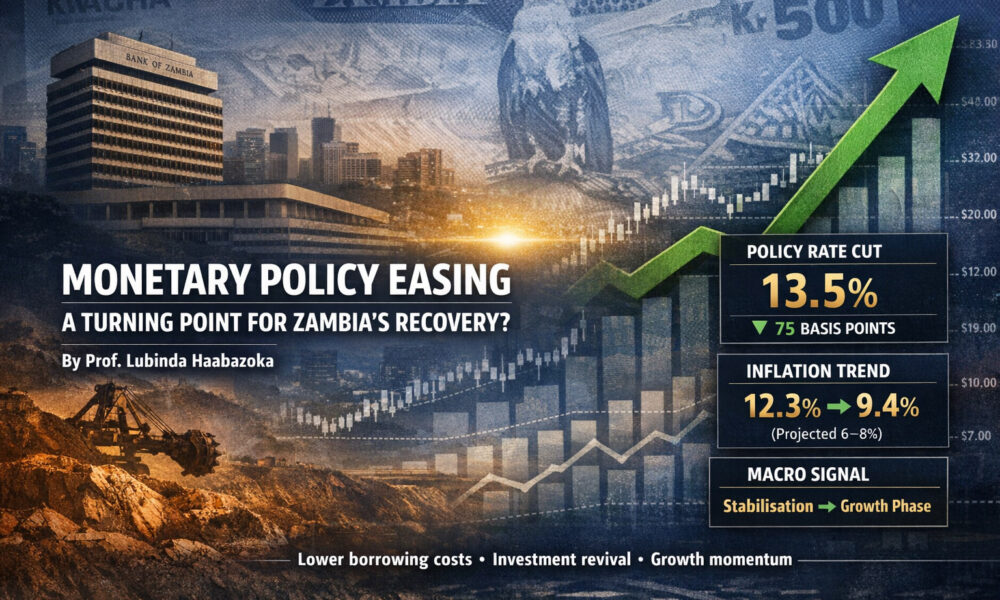
In its latest Monetary Policy Committee (MPC) decision, the Bank of Zambia reduced the Policy Rate by 75 basis points to 13.5 percent, citing the sharp decline in inflation and improved inflation outlook
This decision signals confidence that inflation is easing sustainably and that the economy can accommodate a more supportive monetary stance.
But what does this mean for households, businesses and the economy at large? And where is Zambia coming from?
Zambia’s Macroeconomic Journey Since 2020
To appreciate the significance of this policy shift, we must reflect on the past five years.
In 2020, Zambia became the first African country during the COVID-19 era to default on its external debt. Fiscal pressures mounted, external reserves declined, investor confidence weakened, and the kwacha depreciated sharply.
Between 2020 and 2022, inflation remained elevated, driven by:
Tight monetary policy became necessary to anchor inflation expectations.
Under the IMF-supported programme, Zambia implemented fiscal consolidation and began debt restructuring. Over time:
According to the MPC Statement (February 2026), inflation declined from 12.3 percent in September 2025 to 11.2 percent in December 2025, before falling sharply to 9.4 percent in January 2026
The Bank projects inflation to fall into the 6–8 percent target band by the second quarter of 2026, averaging 6.9 percent in 2026 and easing further to 6.3 percent in 2027
It is within this improved macroeconomic environment that the reduction in the Monetary Policy Rate must be understood.
Implications for Households
For ordinary Zambians, interest rates matter in practical ways:
If commercial banks transmit the rate cut effectively, households could see increased disposable income and improved financial flexibility.
However, if credit standards remain tight, the impact may be gradual.
Implications for Businesses
For businesses, particularly SMEs:
Lower rates can improve profitability margins and stimulate private-sector growth. Capital-intensive sectors such as manufacturing, agriculture and construction stand to benefit significantly.
Three Macroeconomic Scenarios
The ultimate impact depends on how conditions evolve over the next 12–24 months. Three scenarios are plausible:
Scenario 1: The Optimistic Case – Growth Acceleration
In this scenario:
This would represent a virtuous cycle of macroeconomic recovery, strengthening household incomes and business confidence.
Scenario 2: The Base Case – Moderate Expansion
Here:
Households benefit modestly, and businesses expand cautiously. The recovery continues, but without dramatic acceleration.
Scenario 3: The Downside Case – Inflation Re-emergence
In this scenario:
In such a case, short-term relief from lower interest rates could give way to renewed macroeconomic instability.
Broader Economic Implications
The reduction in the Policy Rate is not simply about cheaper loans. It signals that Zambia’s macroeconomic stabilisation strategy is yielding results.
It reflects:
However, monetary policy alone cannot drive long-term transformation. Structural reforms, fiscal discipline, diversification and productivity growth remain essential. That is why we have continuously commended the government on its fiscal discipline. Fiscal discipline is the father of public financial management success!
The reduction of the Monetary Policy Rate to 13.5 percent represents a calculated move toward supporting economic recovery while maintaining inflation discipline.
For households, it offers relief and opportunity.
For businesses, it lowers the cost of capital and encourages expansion.
For the economy, it marks a transition from stabilisation toward growth.
The key question now is not whether the rate cut was justified. The key question is whether Zambia can leverage this window of monetary easing to accelerate inclusive growth, strengthen productive sectors, and build resilience against future shocks.
If managed prudently, this could mark the beginning of Zambia’s next phase of sustainable economic expansion.
BoZ cuts policy rate to 13.5% as inflation continues to ease
Zambia’s Economic Repositioning in 2025: Consolidation, Confidence, and the Path to Inclusive Growth
Zambia’s Foreign Exchange Reserves Hit a Historic US$5.2 Billion: A Turning Point for the Economy
Zambia’s Credit Rating Upgrade, What It Means for Our Economy and Our Daily Lives
Zambia’s Renewed Momentum, led By President Hakainde Hichilema Is Setting The Pace For Africa
Your email address will not be published.
Published
on
By
FOLLOWING a sharp decline in inflation, the Bank of Zambia (BoZ) Monetary Policy Committee has reduced the Policy Rate by 75 basis points to 13.5 percent.
BoZ Governor Dr Denny Kalyalya said the decision was informed by the further decline in inflation in the fourth quarter of 2025, the projected faster fall of inflation into the 6–8 percent target band than was forecast in November 2025, and the need to maintain an appropriate monetary policy stance.
He said inflation continued to decelerate in the fourth quarter of 2025, with overall inflation declining to 11.2 percent in December 2025 from 12.3 percent in September 2025.
Dr Kalyalya said inflation fell sharply to 9.4 percent in January 2026, largely driven by the continued impact of the maize bumper harvest from the 2024/2025 farming season and the appreciation of the Kwacha against major currencies.
He disclosed that current projections indicate inflation will fall into the 6–8 percent target band at a faster pace than was forecast in November 2025.
“Further, it is expected to be within the band by the second quarter of 2026 and move to the lower bound by the second quarter of 2027,” Dr Kalyalya said.
He said, on average, inflation is forecast to be 6.9 percent in 2026, compared to 7.6 percent projected in November 2025.
The Central Bank Governor further said inflation is expected to ease to 6.3 percent in 2027.
He said the more positive outlook largely reflects the lagged effects of the recent appreciation of the exchange rate and expected favourable agricultural output.
“The risks to the inflation outlook remain tilted to the downside. These include favourable weather conditions, supportive external sector conditions reflected in higher copper prices, and continued macroeconomic stability,” Dr Kalyalya said.
(Mwebantu, Wednesday, 11th Februray, 2026)
Published
on
By
LOCAL Authority Public Relations Officers (LAPRO) have awarded Permanent Secretary Gabriel Pollen, Nicholas Phiri and former Ministry of Local Government Permanent Secretary Maambo Hamaundu in recognition of their outstanding contribution to uplifting and professionalising the role of public relations officers within local authorities.
In a statement issued by the public relations practitioners, the three Permanent Secretaries, working collaboratively with other key partners, were presented with Excellence Awards for their unwavering support and recognition of the critical role public relations professionals play in councils across the country.
The practitioners said the leadership of the three public servants has significantly enhanced the visibility, credibility and effectiveness of public relations functions within the local government system.
They said that over the years, the support has translated into improved institutional communication structures, greater inclusion of public relations officers in decision-making processes and increased appreciation of strategic communication as a tool for service delivery.
The Local Authority Public Relations Officers further extended their appreciation to President Hakainde Hichilema for demonstrating positive political will towards the growth and professional recognition of public relations within councils.
“This commitment has created an enabling environment for effective communication at local government level,” they said.
Gratitude was also extended to the Ministry of Local Government and Rural Development (MLGRD), the Local Government Service Commission, past and present Ministers of Local Government and Rural Development, the Presidential Delivery Unit and all cooperating partners whose collective support continues to strengthen communication, transparency and public engagement in local authorities.
The Local Authority Public Relations Officers’ representatives, including Christine Kabaso, Tasila Banda, Rabecca Mushibi, Canicius Mushibwe, Kamona Lindunda, Veronica Sampa, Nakubiana Shabong and Mushota Mpundu, reaffirmed their commitment to upholding professional standards, ethical communication and proactive public engagement in support of national development and effective local governance.
(Mwebantu, Tuesday, 10th Februray, 2026)
Published
on
By
PRESIDENT Hakainde Hichilema has encouraged African countries to change the narrative surrounding the International Monetary Fund (IMF), urging them to take ownership of their economic recovery programmes.
He said countries must design their own recovery strategies and invite the IMF to support them, rather than the other way around.
Speaking during his keynote address on the opening day of the Investing in African Mining Indaba 2026, the largest event of its kind and a pivotal platform for mining professionals, investors and industry leaders, President Hichilema said IMF programmes should prioritise growth, not only fiscal consolidation and macroeconomic stability.
“We must construct our own recovery programmes and ask the IMF to support us. Those programmes should be about growth, not just fiscal consolidation and macro stability,” he said.
President Hichilema said mining holds the key to revitalising Africa and ensuring the continent takes its rightful place at the forefront of the global economy.
He said the New Dawn Administration had placed the revitalisation of Zambia’s mining sector at the centre of its economic agenda by creating regulatory certainty, enhancing transparency, strengthening institutions and deploying game-changing mining technologies to drive long-term growth.
President Hichilema said the Mining Indaba symbolises Africa’s dream of transformative partnerships.
“Zambia agrees that we are stronger together. We all have capabilities, endowments, skills and experience, but no single one of us has enough to deliver the total package for our economies,” he said.
He added that transforming Africa’s fortunes through mining would require providing a clear and credible path for partners and investors to follow.
“We have to take leadership. If we do that, others will support our strategies. It is easy to support people with a clear vision, but we must get organised so we can be worthy partners in the global community,” he said.
The President outlined several achievements as Zambia works towards its medium-term target of producing three million tonnes of copper per year.
He said his government inherited a mining sector in difficulty.
“We have been planting the seeds of reform. Over US$12 billion in new investment has followed. Kansanshi, Lumwana, Mopani and KCM are all back on track. Copper production rose by 12 per cent in 2024 and a further eight per cent in 2025,” he said.
President Hichilema said the country’s target is to reach three million tonnes of copper within a decade, adding that the geological survey is opening up new exploration areas.
“New investors are entering Zambia. We are building the infrastructure and institutions to make it happen. For every Zambian, more mining means more jobs, more revenue for schools and clinics, and more opportunities for local businesses.
“Zambia is open, stable and committed to finishing what we started. The seeds are sprouting and the harvest is coming,” he said.
Earlier, South African Minister of Mineral and Petroleum Resources Gwede Mantashe said it was imperative for Africa to act collectively and speak with one voice to the mining sector.
“Trade unionists understand that workers cannot negotiate alone. The same applies to Africa. We must negotiate mining and beneficiation deals with the rest of the world as a single economy,” he said.
(Mwebantu, Tuesday, 10th Februray, 2026)
© Copyright © 2025 Mwebantu. All Rights Reserved. Zambia’s leading Social news platform.