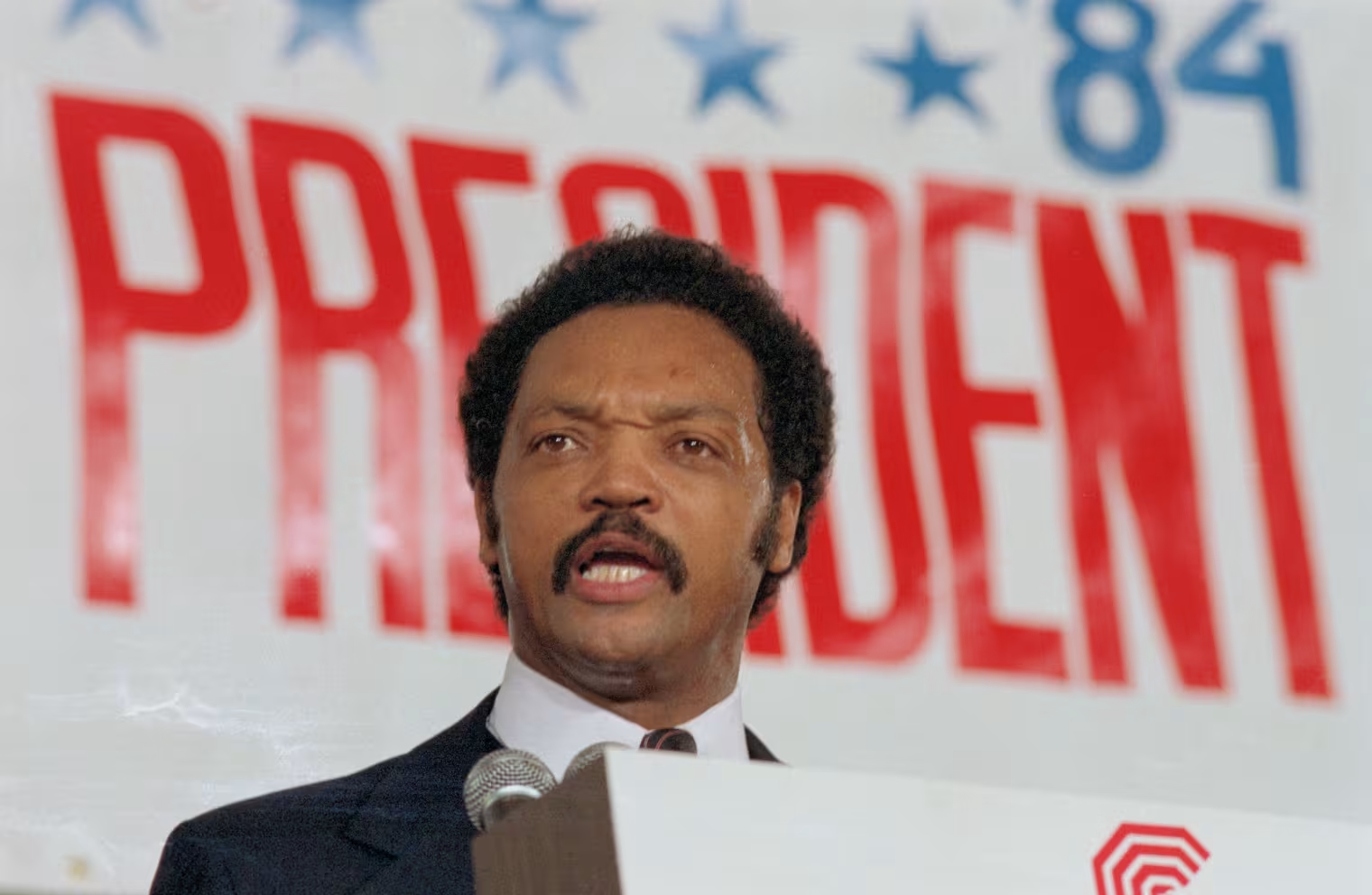

The Reverend Jesse Jackson, the longtime United States civil rights activist, Baptist minister, and two-time presidential candidate, has died at the age of 84, his family announced on Tuesday.
Although the exact cause of death was not immediately disclosed, the family said Jackson “died peacefully surrounded by his loved ones,” according to a report by NBC.
He had been hospitalised in November and had lived for more than a decade with progressive supranuclear palsy (PSP), a rare neurological disorder that affects mobility and swallowing and can lead to severe complications, according to the Rainbow PUSH Coalition.
“Our father was a servant leader, not only to our family, but to the oppressed, the voiceless, and the overlooked around the world. We shared him with the world, and in return, the world became part of our extended family,” the Jackson family said in a statement.
They added that his lifelong commitment to justice, equality and love had uplifted millions and urged the world to honour his legacy by continuing the fight for the values he championed.
Jackson publicly revealed his Parkinson’s diagnosis in 2017 and had been receiving outpatient treatment at Northwestern Medicine for at least two years prior to announcing it.
The family said public observances would be held in Chicago, and additional details on celebration of life events would be announced by the Rainbow PUSH Coalition.
Key Facts About Rev. Jesse Jackson
1. Jackson was born in Greenville and rose to prominence during the U.S. civil rights era, participating in demonstrations alongside Martin Luther King Jr..
2. His activism extended into politics, where he twice sought the Democratic presidential nomination, in 1984 and 1988. In the 1984 race, he won more than 18 percent of the primary vote and several primaries and caucuses.
“Merely by being black and forcing other candidates to consider his very real potential to garner black votes, which they need, Jackson has had an impact,” wrote the New York Times in 1984.
In 1988, he improved his performance, winning 11 primaries and caucuses.
3. Jackson began his career as an organiser with the Congress of Racial Equality, participating in sit-ins and marches. He studied at North Carolina A&T State University, graduating with a sociology degree.
4. While pursuing divinity studies at Chicago Theological Seminary, he rallied student support for King and took part in the 1965 Selma-to-Montgomery march.
5. Shortly thereafter, he joined the Southern Christian Leadership Conference (SCLC) to work alongside King full time.
6. Jackson won praise from King for his leadership of SCLC’s economic empowerment programme, Operation Breadbasket — “we knew he was going to do a good job, but he’s done better than a good job,” King said.
Read More: Former President Lungu dies in South African hospital, family confirms
7. His 1984 campaign faced controversy when he used a slur referring to Jewish people, calling them “hymies” and describing New York City as “hymietown.” He initially denied the remarks, later admitted them, and issued an emotional public apology.
8. In 1991, Jackson was elected one of Washington, D.C.’s two “shadow senators,” advocating for D.C. statehood.
9. Jackson played critical roles in securing the release of several Americans detained abroad, including three U.S. soldiers held in Yugoslavia in 1999. For this, President Bill Clinton awarded him the Presidential Medal of Freedom in 2000.
10. His humanitarian interventions also included securing the release of a U.S. Navy pilot from Syria in 1984, at least 16 Americans held in Cuba the same year, 700 women and children from Iraq in 1990, and two Gambian Americans imprisoned in 2012.
11. Jackson remained vocal on contemporary politics, criticising leading U.S. figures including former President Donald Trump, and stating that “Fifty years of civil rights have been threatened.”
He endorsed Senator Bernie Sanders in the 2020 presidential race, with Sanders saying: “It is one of the honors of my life to be supported by a man who has put his life on the line for the last 50 years fighting for justice.”
WARNING! All rights reserved. This material, and other digital content on this website, may not be reproduced, published, broadcast, rewritten or redistributed in whole or in part without prior express permission from ZAMBIA MONITOR.
Your email address will not be published. Required fields are marked *

Social Media
Communication
Bookmarking
Developer
Entertainment
Academic
Finance
Lifestyle
You may be interested
“Ruth Grand Phiri and Her Commitment to Transforming Chipata City”
Ruth Grand Phiri is widely recognized as an inspiring and...
Women and girls in science: Dismantling barriers, closing gender gaps
Facebook Twitter Print Email Although women are more likely than...
UN warns civilians remain at risk as airstrikes continue across Gaza
Facebook Twitter Print Email Fresh airstrikes and shelling across the...