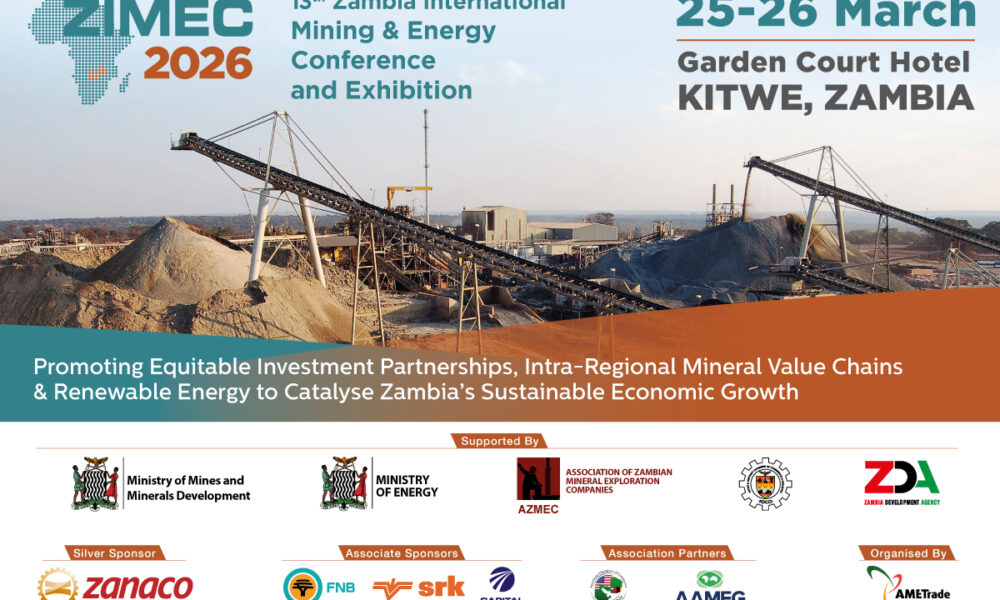










ZIMEC 2026 to Spotlight Zambia’s Exploration Renaissance: Unpacking How Innovation, Policy, and Technology Are Shaping the Next Mineral Boom
President Hichilema urges business community to consider lowering prices of goods
Government successfully completes IMF programme, records US$5billion rise in foreign reserves
When Government Bonds Are Oversubscribed: What It Really Means for Zambia’s Economy
Yango Partners with Flutterwave to Strengthen Secure Digital Payments for Food Delivery in Zambia
Government to recruit 4000 teachers and health workers this year reveals President Hakainde Hichilema
Attack on police is attack on Zambia
Immigration Blocks two Zambian women Seeking Domestic Jobs in Oman, Lebanon
Violent motorist arrested for assaulting traffic police Officer in Ndola.
Husband man on the run after stabbing wife in Lusaka, police say
ECZ begins online inspection of provisional register of voters, ahead of general elections.
Police find 16 Tonse Alliance members locked in lodge.
Don’t glorify corrupt people, report them says HH
Dr Muchima denies being fired over Bill 7.
UPND government records gains in unity and investment, President Hakainde Hichilema
Police arrest Junior
Attack on police is attack on Zambia
Violent motorist arrested for assaulting traffic police Officer in Ndola.
Husband man on the run after stabbing wife in Lusaka, police say
Mkushi cop shoots self, dies
Gunmen rob Mufulira Wanderers more thank K180,000 in gate takings
Power Dynamos boost quarterfinal hopes with Berkane win.
Power Dynamos back in business
Zesco United suffer elimination
Lusaka Fitness Squad’s heartwaring initiative raises K63,015 for National Heart Hospital, supporting child-friendly facilities and resources.
1xBet Christmas Road Show is where your dreams come true!
Time to Win Big – Megapari is officially in Zambia!
Megapari Joined the Celebration at the Nc’wala Ceremony in Zambia
22Bet Zambia: Sculpting the Future of Sports and Casino Gaming
Discover the King of DRAG with 1XBET
Published
on
By
The 13th Zambia International Mining & Energy Conference & Exhibition (ZIMEC 2026), to be held on 25-26 March 2026 in Kitwe, Zambia, will zero in on one of the most vital conversations for Zambia’s mineral future: how to accelerate exploration and de-risk the hunt for new deposits through technology, partnerships, and smart policy.
Under the theme “Promoting Responsible Investment & Partnerships to Sustainably Grow Zambia’s Mining and Energy Sectors”, ZIMEC 2026 provides a strategic platform for government leaders, mining companies, investors, geoscientists, and development partners to explore how discovery – not just production – will sustain Zambia’s role as a critical minerals hub in the decades ahead.
Exploration: The Lifeblood of Zambia’s Mineral Future
A highlight of this year’s conference will be the Exploration Panel, titled: “Accelerating mineral discovery: De-risking exploration and leveraging technology to advance the search for minerals.” This session recognises that exploration is far more than just drilling but it’s the foundation of future investment, value creation, and long-term growth for Zambia’s mining sector.
Key topics to be addressed include:
What to Expect at the Session
Join Us at ZIMEC 2026
ZIMEC 2026 is not just a conference — it’s a catalyst for exploration-led growth. The exploration panel will be a strategic moment for all stakeholders to come together, share lessons, and commit to the future of Zambia’s mineral discovery journey.
Registration is now open for delegates, exhibitors, and sponsors. For more information, including programming and exhibition opportunities, please visit https://zimeczambia.com/ or contact Conference Producer, Babongile Zulu at [email protected]. Join the conversation on social media using the hashtag #ZIMEC.
President Hichilema urges business community to consider lowering prices of goods
Yango Zambia Reflects on Its Impact, Innovation and Community Support In 2025
From Jerusalem To Lusaka: Building Bridges Of Growth And Opportunity
Dotcom Zambia to Launch Global E-Commerce Platform for Zambian Companies
Your email address will not be published.
Published
on
By
PRESIDENT Hakainde Hichilema has urged more business entities to consider lowering the prices of goods following the good performance of the Kwacha, both locally and internationally.
Mr Hichilema commended the Zambia Association of Manufacturers (ZAM) for positively responding to Government’s call for the business sector to reduce prices of goods following the positive economic fundamentals, with inflation going down.
“We commend the Zambia Association of Manufacturers (ZAM) for responding to the positive economic fundamentals by lowering prices, and we urge others to do the same,” Mr Hichilema said.
The President said this yesterday in Parliament when he addressed the nation on progress made on the application of national values and principles.
“The kwacha has been one of the best performing currencies in the world, inflation is coming down, and other economic fundamentals are getting better, with a clear, positive alignment.
“At the same time, we acknowledge that citizens are yet to feel the full benefits, and that the cost of living should be stabilised further,” Mr Hichilema, a farmer and economist, said.
The President notes that with macro-economic stability now firmly in place, the benefits will increasingly be felt by the citizens through a gradual but sustained easing of the cost of living.
“As we work to increase wages, we will also work with the private sector to help further drive down the cost of doing business and thereby stabilise prices for the benefit of our people,” Mr Hichilema said.
And the President said national values and principles are an embodiment of who we are as a people. Our national character and policy choices are firmly anchored on these values and principles.
“As such, notwithstanding the tremendous progress we have made, together, we have more work to do.
We all have a duty to turn our national values and principles into action from a place of love and deep care for our people, and the nation’s wellbeing”.
(Mwebantu, Saturday, 21st Februray, 2026)
(Picture by Chellah Tukuta)
Published
on
By
GOVERNMENT has successfully concluded a 38-months International Monetary Fund Extended Credit Facility (IMF)-(ECF) programme which commenced in August 2022 and culminated in an immediate disbursement of US$190.0million, bringing the total programme support to US$1.7 billion.
Minister of Finance and National Planning Situmbeko Musokotwane said this development means that Government has broadly met all programme benchmarks and targets under the current IMF-supported arrangements.
“Government has decided not to request an extra one-year extension of the programme. Instead, we will immediately engage in talks with the IMF on a successor programme which envisioned to focus on supporting growth, investment, job creation, and expansion of Zambia’s productive capacity,” Dr Musokotwane said.
He this in a ministerial statement on the performance of the economy and update on IMF-EFC programme as at December 2025.
The minister also shared some key achievements from the programme which include restored macroeconomic stability and fiscal discipline.
“Fiscal consolidation efforts undertaken under the Programme have been successful. The fiscal deficit, which I have already alluded to, is expected to be 3.8 percent below the target of 4.6 percent in 2025 from 9.0 percent in 2021.
“This was mainly achieved through expenditure rationalisation and improved revenue collection to address other development needs and improve access to public service”.
Meanwhile, Zambia’s public debt as at end of December 2025 stood at US$28.9 billion, comprising US$16.1 billion in Central Government external debt, US$1.4 billion in Government‑guaranteed external debt.
Minister of Finance and National Planning Situmbeko Musokotwane said domestic debt stands at, K253.7 billion.
Dr Musokotwane said the stock of domestic debt contracted through the issuance of Government securities increased marginally by 0.4 percent, rising from K252.8 billion in September 2025 to K253.7 billion as at end- 2025.
“This upward trend was consistent with the programmed financing requirements for the budget deficit, as approved in the 2025 Annual Borrowing Plan,” he said.
Dr Musokotwane said this in a ministerial statement on the performance of the economy and update on the International Monetary Fund (IMF) Extended Credit Facility (EFC) programme as at 31st December 2025.
“On the external side, the Central Government’s debt stock rose by 0.7 percent increase to US$16.1 billion from US$16.04 billion in September 2025. This increase was primarily driven by disbursements received from our multilateral partners”.
Meanwhile, the minister said the country’s gross foreign reserves rose to US$5.5 billion in 2025.
“Gross foreign reserves rose to US$5.5 billion at end December from US$5.2 billion at end September 2025. The build-up in reserves was mainly due to the disbursement under the IMF ECF arrangement,” Dr Musokotwane said.
(Mwebantu, Saturday, 21st Februray, 2026)
Published
on
By
By Prof. Lubinda Haabazoka
As published in the Daily Nation Wednesday 18th January 2026
In recent days, the Government of the Republic of Zambia (GRZ) bond auction results released by the Bank of Zambia have attracted significant attention. The figures show that the bond auction was heavily oversubscribed. But what does this mean? And why should ordinary citizens, businesses, and policymakers care?
Let us begin with the basics.
What Is a Bond?
A bond is essentially a loan. When you buy a government bond, you are lending money to the government for a specified period. In return, the government promises two things:
1. To pay you interest (called a coupon) at an agreed rate, and
2. To repay your principal (the original amount invested) at maturity.
Unlike Treasury Bills, which are short-term (usually less than one year), government bonds are medium- to long-term instruments, typically ranging from 2 years to 15 years or more.
Who Issues Government Bonds?
In Zambia, government bonds are issued by the Ministry of Finance through the Bank of Zambia (BoZ), which acts as the government’s agent. The BoZ conducts regular auctions where institutional investors such as commercial banks, pension funds, insurance companies, asset managers, and sometimes individuals submit bids indicating how much they are willing to invest and at what interest rate.
Why Does Government Issue Bonds?
Government bonds serve several important purposes:
● Financing infrastructure such as roads, schools, and hospitals
● Supporting budget deficits when revenue is insufficient
● Refinancing maturing debt
● Developing the domestic capital market
● Providing safe investment instruments for pension funds and financial institutions
A well-functioning bond market is a cornerstone of financial sector development and macroeconomic stability.
What Happened in the Latest Auction?
According to the Bank of Zambia’s official results for Bond Tender No. 02/2026/BA held on February 13, 2026:
● Total amount offered: K4.2 billion
● Total amount bid: K21.335 billion
● Total amount allocated: K9.879 billion
In simple terms, investors were willing to lend the government more than five times the amount initially offered.
For example:
● The 15-year bond had K560 million on offer but received bids totaling K8.824 billion
Bonds-Press-Results-02-2026-BA
.
● The 10-year bond had K600 million offered but attracted K4.287 billion in bids
Bonds-Press-Results-02-2026-BA
This is what we call oversubscription. When demand for bonds exceeds the amount the government is seeking to borrow.
What Does Oversubscription Mean?
Oversubscription sends several powerful signals about the economy. In an election year, oversubscription is a signal from investors of approving continuity and being sure that those managing economic affairs of the country will be around beyond the elections. Other meanings include:
1. Strong Investor Confidence
When investors aggressively bid for long-term government bonds, it suggests:
● Confidence in macroeconomic stability
● Belief that inflation will moderate over time
● Trust that the government will honor its debt obligations
Investors do not commit billions of kwacha to 10- or 15-year instruments unless they believe the economic environment will remain relatively stable.
2. Excess Liquidity in the Financial System
Oversubscription can also indicate that there is substantial liquidity in the banking system. Commercial banks and institutional investors may be sitting on surplus funds and view government bonds as a safe and attractive investment.
This is particularly likely in an environment where:
● Private sector credit growth is moderate
● Risk appetite toward SMEs is cautious
● Banks prefer low-risk sovereign assets
3. Attractive Yields
The auction results show cut-off yields ranging from:
● 14.5% for 2-year bonds
● 16.6% for 10-year bonds
● 17.59% for 15-year bonds
Bonds-Press-Results-02-2026-BA
In a declining inflation environment, these yields may be viewed as attractive in real terms, especially for pension funds seeking long-term predictable returns.
Is Oversubscription Always Good News?
While oversubscription is generally positive, it must be interpreted carefully.
The Positive Side
● It reduces borrowing pressure.
● It allows government to reject excessively high interest rate bids.
● It demonstrates market appetite for government securities.
● It supports development of Zambia’s domestic capital market.
The Cautionary Side
If banks prefer buying government bonds instead of lending to businesses, we may see a phenomenon called crowding out, where private sector credit growth slows.
When financial institutions can earn 16–17% from government bonds with minimal risk, they may become less incentivized to lend to SMEs or entrepreneurs who carry higher default risk.
This can affect job creation and private sector expansion.
What Does This Mean for Households and Businesses?
For households:
● Strong bond demand can reflect macroeconomic stability.
● Stable yields may support pension fund performance.
● It may signal confidence in long-term inflation control.
For businesses:
● If liquidity remains strong, lending rates may gradually decline.
● However, if government borrowing expands aggressively, private sector credit could tighten.
For the broader economy:
● Oversubscription enhances Zambia’s credibility in domestic debt markets.
● It strengthens the case for reduced reliance on external commercial borrowing.
● It deepens financial market development.
The Bigger Picture
In recent years, Zambia has been navigating debt restructuring, inflation pressures, and currency volatility. A bond market that is oversubscribed five times over suggests that domestic investors are increasingly confident in macroeconomic direction.
However, policymakers must strike a careful balance:
● Maintain fiscal discipline.
● Ensure borrowing finances productive investments.
● Avoid excessive domestic debt accumulation.
● Promote private sector credit growth.
Oversubscription is not merely a technical financial term. It is a reflection of market sentiment. It tells us how investors view Zambia’s economic trajectory.
At this stage, the signal appears positive.
But sustained confidence will depend on continued macroeconomic prudence, inflation management, and growth in real sector productivity.
Government bond oversubscription is therefore not just about numbers. It is about trust — and trust is the currency of economic stability.
Dr Lubinda Haabazoka is Associate Professor of Banking and Financial Economics and Director at the Graduate School of Business, University of Zambia.
© Copyright © 2025 Mwebantu. All Rights Reserved. Zambia’s leading Social news platform.
ZIMEC 2026 to Spotlight Zambia’s Exploration Renaissance: Unpacking How Innovation, Policy, and Technology Are Shaping the Next Mineral Boom