
Give Us Back Our Land, eSwatini implores South Africa
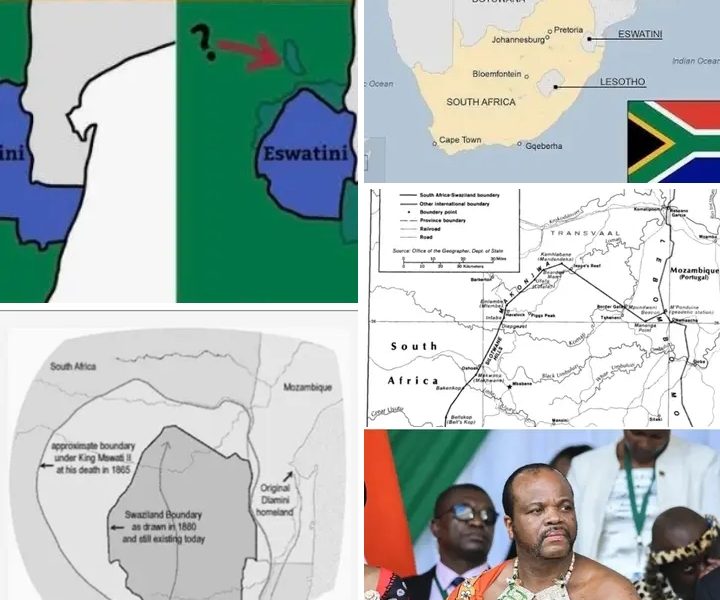
The Republic of South Africa has received petitions from representatives of Eswatini’s monarchy, that demand for the return of land they claim belongs to Eswatini, including all of Mpumalanga and parts of KwaZulu-Natal provinces.
This territorial claim dates back to the 1800s and latest demand follows King Mswati III’s 2025 establishment of a Border Restoration Committee to examine the longstanding territorial claims.
The history of the dispute dates back to the 19th century during the “Scramble for Africa,” when between 1881 and 1884, British colonial authorities and the South African Republic (the Boer Republic of the Transvaal) drew up boundaries without the knowledge and consent of the Swazi King, Mbandzeni.
These treaties—specifically the Pretoria Convention (1881) and the London Convention (1884)—severely shrunk the kingdom’s borders, beinging millions of ethnic Swazis living outside their homeland to be under South African rule.
In 1982 eSwatini came closest to reclaiming this land during a highly controversial, secret deal with South Africa’s apartheid government, led by P.W. Botha. The Government made proposals to surrender KaNgwane and Ingwavuma to Swaziland (under King Sobhuza II).
However, by so doing, South Africa could strip nearly 800,000 Black South Africans of their South African citizenship, making them foreign nationals of Swaziland under apartheid logic.
The move would have created a geographic buffer between South Africa and Mozambique, which was then a base for anti-apartheid liberation fighters.
As a result these considerations, the deal ultimately collapsed due to massive domestic resistance. Local leaders in KaNgwane (led by Enos Mabuza) and the KwaZulu homeland (led by Mangosuthu Buthelezi) fiercely opposed the plan, and South African courts ultimately blocked the land transfer.
However, roday the eSwatini authorities have continued to demand these territorial claims through diplomatic channels, managed by a permanent, king-appointed body called the Border Restoration Committee (BRC), but without much progress.
The African Union Rule: The African Union (AU) strictly adheres to the principle of uti possidetis—the agreement to respect colonial-era borders to prevent continent-wide border wars. Redrawing borders sets a precedent other African nations want to avoid
South Africa’s Stance: While democratic South Africa (led by the ANC) has occasionally engaged in quiet bilateral talks with eSwatini, it has shown no appetite for actually ceding territory, resources, or citizens to an absolute monarchy.
The other problem is that Mpumalanga, despite an international border separating eSwatini and South Africa, boasts of a huge Swazi population that shares a language, culture, and deep historical ties with their neighbors in eSwatini.
Therefore, the territorial claims have far reaching consequences for both countries.