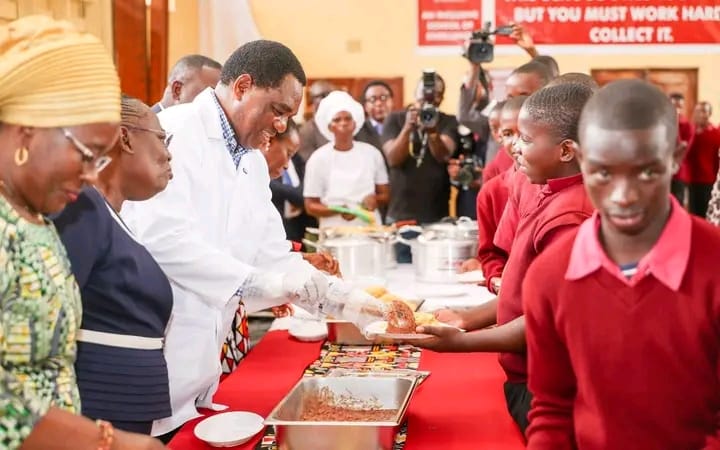

GOVERNMENT has dedicated a budget line of over K500 million per annum to the School Feeding Programme.
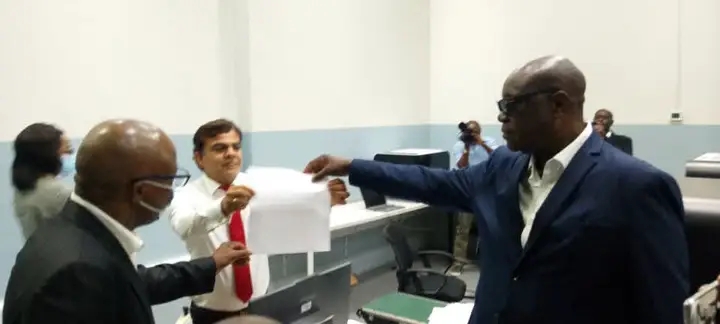
Speaking during the signing of a Memorandum of Understanding between government and Food 4 Education, Monday, Head of the Presidential Delivery Unit, Kusobile Kamwambi, said this demonstrated government’s belief in the education system and the School Feeding Programme.
“The Zambian government has demonstrated its belief in the education system and also its belief in the School Feeding Programme by making sure that it has its own budget line. We have over K500 million dedicated per annum to the School Feeding Programme. But we cannot deliver on our own. We have a lot of cooperating partners that are supporting in various areas of this School Feeding Programme, and in particular, we recognise the importance of collaboration and innovation in improving our systems so that we can all focus on delivery. I think you all have a relentless focus on delivery. And we just want to commend the Office of the Vice President and the Ministry of Education. The fact that you have taken this step to analyse the challenges, to come up with a framework and solutions for these challenges, means that you do have a relentless focus on delivery,” she said.
Kamwambi said PDU had ensured that the Ministry of Education budget puts aside over K100 million to enhance the production unit under the programme.
“We all want to ensure that the delivery of this programme is efficient. We all want to ensure that at the end of the day, we have systems that work. So, looking at what has been presented today, and looking at the various value chains that are associated with this School Feeding Programme, we are excited as the PDU to be supporting this programme. We want to see how the local farmer gets involved. We want to see how the production unit can also contribute to the School Feeding Programme. The Presidential Irrigation Programme has identified the production unit as one of its Tier One members,” she said.
“And this year alone, we have ensured that the Ministry of Education has budgeted for at least one hundred schools to enhance the production unit. We have actually put aside K100 million. This is over and above all the activities that the schools are already doing in producing their own food. We have gone round and we have seen that there are some schools that are already producing their own food, and even though they were told to look at one acre, they are going beyond an acre to produce their own food. And so we have to just make this work. And we have to make sure that the policies that we have put in place are translating into actual results”.
And Kamwambi said prolonged procurement of food and a conducive environment for pupils, among others were among the challenges facing the implementation of the programme.
“We cannot argue that no matter how good the programme is, no matter how good the policy is, we often have to stop and reflect on its implementation. We need to stop and reflect on the results, and I think this is what this event is all about. We have analysed the gaps that are there in the School Feeding Programme. We’ve been able to identify what those gaps are. They have to do with procurement. It shouldn’t take us six months to procure food. We’ve seen all the challenges that we are having in the procurement of this food for the schools. There are gaps also to do with participation of the community, and the farmer should be able to provide this food directly to the school,” said Kamwambi.
“But there are challenges there also that we have identified in terms of data. We have to make sure that all this data is centrally connected and analysed and we are able to know what is happening where. We also know that there are challenges in terms of infrastructure and equipment. Yes, the food is available to the learners, but is there a conducive environment, a shelter for the learners to eat from? Do we have kitchens where this food is being prepared? For those that are preparing the food outside, what happens in the rain season? And so on and so forth. So I think, based on what we have identified, there are some issues in the programme design as well. And we are happy that Food 4 Education has come forward to present some of these solutions and to work together”.
Speaking earlier, Permanent Secretary for Administration in the Office of the Vice President, Lillian Kapusana, reaffirmed government’s commitment to building resilient and sustainable schoolfeeding systems.
“The government of the Republic of Zambia is committed to building resilient and sustainable school feeding systems that are nationally owned and capable of reaching the most vulnerable learners. We recognize that achieving this objective requires innovation, evidence, strong institutions and strategic partnerships. Food 4 Education has emerged as a leading African institution in the School Feeding space, demonstrating how innovation, technology, operational excellence and local ownership can transform the delivery of school meals at scale. We, therefore, welcome this collaboration as an opportunity for Zambia to learn from proven African experiences while developing solutions that respond to our unique national context. Importantly, this partnership supports government efforts to strengthen systems rather than create parallel structures,” said Kapusana.
“The focus on technical assistance, capacity strengthening, knowledge transfer and institutional development aligns well with Zambia’s long-term vision for sustainable programme delivery. As we look ahead, Zambia has an opportunity not only to strengthen its own school feeding systems but also to position itself as a regional leader in advancing child nutrition and school feeding innovation”.
And Food 4 Education Foundation Founder and Chief Executive Officer, Wawira Njiru explained that they will design and establish model kitchens, among other pillars in the MoU.
“These include policy and institutional coordination, programme design and operational systems, data, digitalisation and innovation, budgeting, financing and resource utilisation, and infrastructure and equipment. Government and Food 4 Education will work together to strengthen Zambia’s National School Feeding Programme. Within those pillars, the MoU commits us to specific work. Together, we will establish a hub of excellence on school feeding for Zambia and Southern Africa. We will design and establish model kitchens, centralised facilities equipped to prepare nutritious meals safely, cost-effectively, and at scale. We will work together on policy development and revision. We will build data systems for the real-time monitoring of delivery. We will jointly mobilise resources with development partners. And we will collaborate on hosting the Global Child Nutrition Forum here in Lusaka this November,” said Njiru.
“Across all of this work, the MoU is unambiguous about who leads. Government provides policy direction and oversight. Government continues to deliver the National School Feeding Programme. Food 4 Education provides technical expertise, co-develops programme frameworks, and supports systematic knowledge transfer to national counterparts. Food 4 Education has spent the past 14 years learning what this work looks like in practice. We are an African organization, built from inside the context. We have served more than 200 million meals from farm to spoon, sourcing 80 percent of food locally and regionally from thousands of smallholder farmers across Kenya, Uganda, Ethiopia, and the wider East African region. The economy was already crossing borders. Now the blueprint is too”.
Do you agree that child defilers should be castrated?
Total Votes: 756
Your email address will not be published.
23 Parirenyatwa Road
Rhodes Park
P.O. Box 32147
Lusaka, Zambia
Telephone or WhatsApp:
+26-097-7708285
+26-095-3424603
+26-096-5815078
Email:
diggers [at] diggers [dot] news
editor [at] diggers [dot] news