









When Government Bonds Are Oversubscribed: What It Really Means for Zambia’s Economy
Yango Partners with Flutterwave to Strengthen Secure Digital Payments for Food Delivery in Zambia
Bee owner charged with manslaughter after woman’s death
Export of raw materials no longer fancy says President Hichilema
RTSA registers over 50,000 motorcycles.
Violent motorist arrested for assaulting traffic police Officer in Ndola.
Husband man on the run after stabbing wife in Lusaka, police say
Man found dead in lodge after night out with woman, police say
Police arrest five over alleged harassment, defamation on journalist abduction claims.
Zambians mourn 12-year-old shot dead in Canada school shooting
President Hakainde Hichilema fires Muchima, Mubanga.
‘Zambian elections have never had a proven case of pre-marked ballot papers,’ says ECZ Chief Electoral Officer Brown Kasaro
President Hakainde accords late first female minister official funeral.
DPP files court documents against Lillian Mutambo via DHL
ACC clarifies status of Lusambo properties.
Violent motorist arrested for assaulting traffic police Officer in Ndola.
Husband man on the run after stabbing wife in Lusaka, police say
Mkushi cop shoots self, dies
Man found dead in lodge after night out with woman, police say
Police warn motorists against fleeing accident scenes.
Gunmen rob Mufulira Wanderers more thank K180,000 in gate takings
Power Dynamos boost quarterfinal hopes with Berkane win.
Power Dynamos back in business
Zesco United suffer elimination
Lusaka Fitness Squad’s heartwaring initiative raises K63,015 for National Heart Hospital, supporting child-friendly facilities and resources.
1xBet Christmas Road Show is where your dreams come true!
Time to Win Big – Megapari is officially in Zambia!
Megapari Joined the Celebration at the Nc’wala Ceremony in Zambia
22Bet Zambia: Sculpting the Future of Sports and Casino Gaming
Discover the King of DRAG with 1XBET
Published
on
By
By Prof. Lubinda Haabazoka
As published in the Daily Nation Wednesday 18th January 2026
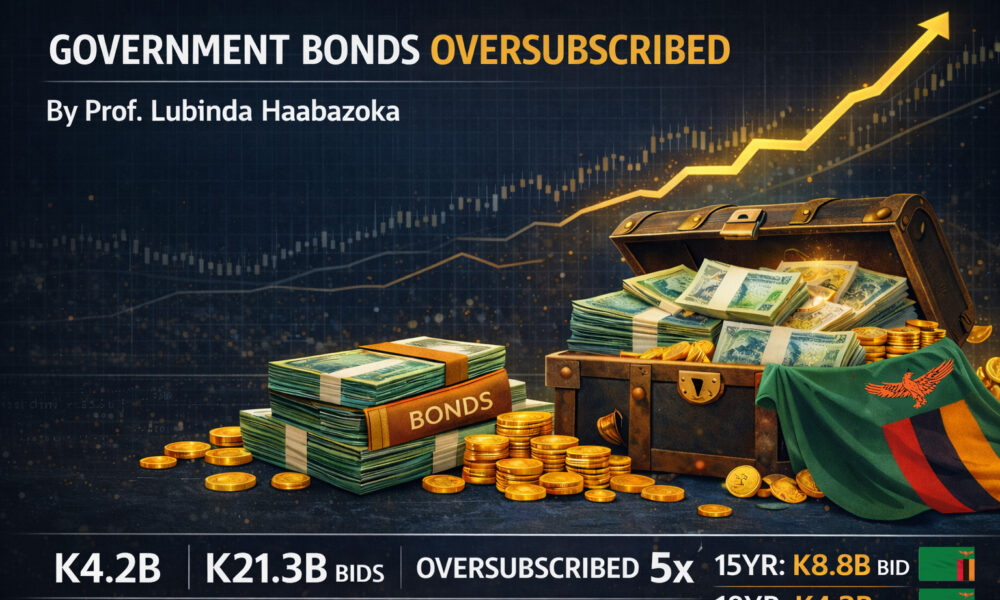
In recent days, the Government of the Republic of Zambia (GRZ) bond auction results released by the Bank of Zambia have attracted significant attention. The figures show that the bond auction was heavily oversubscribed. But what does this mean? And why should ordinary citizens, businesses, and policymakers care?
Let us begin with the basics.
What Is a Bond?
A bond is essentially a loan. When you buy a government bond, you are lending money to the government for a specified period. In return, the government promises two things:
1. To pay you interest (called a coupon) at an agreed rate, and
2. To repay your principal (the original amount invested) at maturity.
Unlike Treasury Bills, which are short-term (usually less than one year), government bonds are medium- to long-term instruments, typically ranging from 2 years to 15 years or more.
Who Issues Government Bonds?
In Zambia, government bonds are issued by the Ministry of Finance through the Bank of Zambia (BoZ), which acts as the government’s agent. The BoZ conducts regular auctions where institutional investors such as commercial banks, pension funds, insurance companies, asset managers, and sometimes individuals submit bids indicating how much they are willing to invest and at what interest rate.
Why Does Government Issue Bonds?
Government bonds serve several important purposes:
● Financing infrastructure such as roads, schools, and hospitals
● Supporting budget deficits when revenue is insufficient
● Refinancing maturing debt
● Developing the domestic capital market
● Providing safe investment instruments for pension funds and financial institutions
A well-functioning bond market is a cornerstone of financial sector development and macroeconomic stability.
What Happened in the Latest Auction?
According to the Bank of Zambia’s official results for Bond Tender No. 02/2026/BA held on February 13, 2026:
● Total amount offered: K4.2 billion
● Total amount bid: K21.335 billion
● Total amount allocated: K9.879 billion
In simple terms, investors were willing to lend the government more than five times the amount initially offered.
For example:
● The 15-year bond had K560 million on offer but received bids totaling K8.824 billion
Bonds-Press-Results-02-2026-BA
.
● The 10-year bond had K600 million offered but attracted K4.287 billion in bids
Bonds-Press-Results-02-2026-BA
This is what we call oversubscription. When demand for bonds exceeds the amount the government is seeking to borrow.
What Does Oversubscription Mean?
Oversubscription sends several powerful signals about the economy. In an election year, oversubscription is a signal from investors of approving continuity and being sure that those managing economic affairs of the country will be around beyond the elections. Other meanings include:
1. Strong Investor Confidence
When investors aggressively bid for long-term government bonds, it suggests:
● Confidence in macroeconomic stability
● Belief that inflation will moderate over time
● Trust that the government will honor its debt obligations
Investors do not commit billions of kwacha to 10- or 15-year instruments unless they believe the economic environment will remain relatively stable.
2. Excess Liquidity in the Financial System
Oversubscription can also indicate that there is substantial liquidity in the banking system. Commercial banks and institutional investors may be sitting on surplus funds and view government bonds as a safe and attractive investment.
This is particularly likely in an environment where:
● Private sector credit growth is moderate
● Risk appetite toward SMEs is cautious
● Banks prefer low-risk sovereign assets
3. Attractive Yields
The auction results show cut-off yields ranging from:
● 14.5% for 2-year bonds
● 16.6% for 10-year bonds
● 17.59% for 15-year bonds
Bonds-Press-Results-02-2026-BA
In a declining inflation environment, these yields may be viewed as attractive in real terms, especially for pension funds seeking long-term predictable returns.
Is Oversubscription Always Good News?
While oversubscription is generally positive, it must be interpreted carefully.
The Positive Side
● It reduces borrowing pressure.
● It allows government to reject excessively high interest rate bids.
● It demonstrates market appetite for government securities.
● It supports development of Zambia’s domestic capital market.
The Cautionary Side
If banks prefer buying government bonds instead of lending to businesses, we may see a phenomenon called crowding out, where private sector credit growth slows.
When financial institutions can earn 16–17% from government bonds with minimal risk, they may become less incentivized to lend to SMEs or entrepreneurs who carry higher default risk.
This can affect job creation and private sector expansion.
What Does This Mean for Households and Businesses?
For households:
● Strong bond demand can reflect macroeconomic stability.
● Stable yields may support pension fund performance.
● It may signal confidence in long-term inflation control.
For businesses:
● If liquidity remains strong, lending rates may gradually decline.
● However, if government borrowing expands aggressively, private sector credit could tighten.
For the broader economy:
● Oversubscription enhances Zambia’s credibility in domestic debt markets.
● It strengthens the case for reduced reliance on external commercial borrowing.
● It deepens financial market development.
The Bigger Picture
In recent years, Zambia has been navigating debt restructuring, inflation pressures, and currency volatility. A bond market that is oversubscribed five times over suggests that domestic investors are increasingly confident in macroeconomic direction.
However, policymakers must strike a careful balance:
● Maintain fiscal discipline.
● Ensure borrowing finances productive investments.
● Avoid excessive domestic debt accumulation.
● Promote private sector credit growth.
Oversubscription is not merely a technical financial term. It is a reflection of market sentiment. It tells us how investors view Zambia’s economic trajectory.
At this stage, the signal appears positive.
But sustained confidence will depend on continued macroeconomic prudence, inflation management, and growth in real sector productivity.
Government bond oversubscription is therefore not just about numbers. It is about trust — and trust is the currency of economic stability.
Dr Lubinda Haabazoka is Associate Professor of Banking and Financial Economics and Director at the Graduate School of Business, University of Zambia.
Yango Partners with Flutterwave to Strengthen Secure Digital Payments for Food Delivery in Zambia
Monetary Policy Easing: A Turning Point for Zambia’s Recovery? By Prof. Lubinda Haabazoka
Zambia Sugar’s market capitalization on LuSE hits USD$1 Billion
Zambia’s Credit Rating Upgrade, What It Means for Our Economy and Our Daily Lives
Your email address will not be published.
Published
on
By
Yango Food, the food delivery service powered by global tech company Yango Group, has partnered with leading African payments technology company Flutterwave to further improve security and convenience of digital payments for customers ordering meals through the platform. The partnership supports Yango Food’s continued expansion of cashless payment options in Zambia, reinforcing its commitment to convenience, security, and financial inclusion in the country’s growing digital economy.
Through the partnership, Yango Food users can now pay for their orders using bank cards processed through Flutterwave’s trusted payment infrastructure. To encourage adoption of digital payments, the service is now having an offer to customers who use card payments. During the month of February 2026, they will get a 20% discount when paying via card on eligible orders. The offer applies to first orders for old and new customers with a minimum value of K180, with customers able to receive a maximum discount of K100 per transaction. Terms and conditions apply.
The partnership comes at a time when Zambia is seeing increasing adoption of digital commerce, particularly in food delivery and online services. By integrating Flutterwave’s trusted fintech infrastructure, Yango Food strengthens transaction security, improves payment reliability, and supports scalable service growth as more customers and restaurant partners move toward cashless transactions.
Speaking about this partnership, Yango Zambia Country Head, Kabanda Chewe, said: “At Yango, we are focused on making our service delivery more convenient, secure, and accessible for our customers and restaurant partners. Partnering with Flutterwave allows us to strengthen our digital payment capabilities while supporting Zambia’s transition toward a more digitally enabled economy. This is an important step in improving the overall experience for customers and helping restaurants grow through reliable digital transactions.”
“Our partnership with Yango represents Flutterwave’s commitment to making payments seamless and accessible across Africa,” said Iyembi Nkanza, Country Head at Flutterwave. “By integrating our payment infrastructure with Yango’s platform, we’re empowering Zambians with secure, convenient payment options that remove friction from everyday transactions. This is exactly the kind of innovation that drives financial inclusion forward.”
Beyond payments innovation, Yango Food continues to invest in Zambia through technology-driven services, partner empowerment initiatives, and collaborations that support local businesses. The integration of trusted card payments through Flutterwave forms part of Yango’s broader vision to build a connected service ecosystem that benefits customers, restaurants, and delivery partners.
Yango Food will continue to expand its partnerships, service features, and technology solutions designed to improve the customer experience while supporting the growth of Zambia’s digital commerce landscape.
Published
on
By
POLICE in Lusaka have arrested and charged a 60-year-old man in connection with the death of a 77-year-old woman who was allegedly attacked and killed by bees kept by the suspect.
The deceased is said to have sustained fatal injuries after being swarmed and stung by the bees.
The suspect, Gratias Matunda Paschal, of Lusaka, has been formally charged in connection with the incident, which occurred on February 2, 2026, in the Hellen Kaunda area.
Police spokesperson Godfrey Chilabi said that on February 17, 2026, around 09:30 hours, Mr Paschal reported himself to police after being summoned through his legal representatives.
Mr Chilabi said it is alleged that Mr Paschal unlawfully kept bees without a permit on Plot Number 217 in Hellen Kaunda, a residential area.
“This unlawful act or omission resulted in the death of Judith Malango, aged 77, due to multiple bee stings, and also caused harm to other persons,” Mr Chilabi said.
He said the suspect has been charged with one count of manslaughter, contrary to Section 199 of the Penal Code, Chapter 87 of the Laws of Zambia, as read together with Sections 56 and 80 of the Animal Health Act No. 27 of 2010.
Mr Chilabi said Mr Paschal has also been charged with three counts of unlawful acts causing harm, contrary to Section 238 of the Penal Code, Chapter 87 of the Laws of Zambia, as read together with Sections 56 and 80 of the Animal Health Act No. 27 of 2010.
He said the charges relate to the death of Mrs Malango and injuries sustained by Mambwe Mwansa (28), Martin Kalenga (45) and Miyanda Sunga (48), all residents of Hellen Kaunda.
Mr Chilabi said the suspect is currently in custody awaiting court appearance.
He said that on February 2, 2026, around 14:50 hours, Kalingalinga Police Post received a report from Richard Ngoma (68), of Libala Stage One, that his aunt, Mrs Malango of Hellen Kaunda, had been stung by bees earlier that morning around 10:00 hours and later died.
Mr Chilabi said a post-mortem examination conducted on February 3, 2026, confirmed that the cause of death was multiple bee stings.
“The Zambia Police Service wishes to thank the family of the deceased, the families of the other victims, the residents of Hellen Kaunda and surrounding areas, as well as the Lusaka City Council, for their patience and cooperation during investigations,” Mr Chilabi said.
(Mwebantu, Wednesday, 18th Februray, 2026)
Published
on
By
PRESIDENT Hakainde Hichilema says African countries are no longer keen on exporting raw materials but want value addition to what they produce.
The President says the African continent is now awake and leaders are ‘speaking one language.’
“I’m just from the AU and we are speaking one language now, that we cannot continue exporting raw materials for centuries.
“We will not and we don’t want those discussions. We want discussions that will lead us into responsible resource extraction, processing, value addition. That will add growth to our economies for jobs and business opportunities and treasury revenues,” President Hichilema said during a bilateral meeting with UN Trade and Development (UNCTAD) secretary general Rebeca Grynspan at State House yesterday.
The President said time is now for Zambia to advance conversations with UNCTAD beyond traditional partnerships.
“We would like to see more harmonisation and rationalisation of what your office locally does and what your leadership does at the international level.
“When we rationalise and consolidate, we can be more effective and focusing on outcomes,” President Hichilema said.
He added that the ultimate goal of all the convoluted things which the Zambian government, with its partners, does, is to see deliverables.
“We have to deliver in a way that will make the economy to function. We appreciate the support that you (UNCTAD) gave us in the debt restructuring, the support you give us in ASYCUDA area. ASYCUDA must deliver results,” he said.
Automated System for Customs Data (ASYCUDA) is a comprehensive, computerised customs management system developed by UNCTAD to modernise international trade procedures and used in over 100 countries.
The initiative automates cargo control, customs declarations, accounting, and risk management.
President Hichilema said electronic commerce is very important and must take root in Zambia.
“Transactions must be anchored on digital platforms or e-commerce and that will cut out delays and negative vices. “Digital platforms help us to reduce negative vices and thereby enhance treasury incomes,” President Hichilema said.
Ms Grynspan said: “Zambia is a country that we have been following very carefully. It’s a country that has become a strategic regional hub.”
“The country has transformed from being landlocked to land-linked advantage, serving as a vital transit and as an energy corridor for COMESA, SADC and with the African Free Trade Area.
“So to transform a weakness into a strength has to be highlighted, with respect to Zambia,” said Ms Grynspan.
© Copyright © 2025 Mwebantu. All Rights Reserved. Zambia’s leading Social news platform.
When Government Bonds Are Oversubscribed: What It Really Means for Zambia’s Economy