
By Deeleslie Mondoka
CONCOURT CLARIFIES ECZ’S ROLE PA NKANI YAMA ADOPTION CERTIFICATES
We begin today’s commentary with a simple but important question:
Does the Constitution require both the party president and secretary general to sign an adoption certificate?
And the ConCourt’s answer, in plain English, is this:
No. The Constitution does not sit there with a checklist saying, “Thou shalt have two signatures, one for the president, and the other for the secretary general, and no shortcuts.”
But before anyone runs off with that answer like smoke without fire, thinking the matter ends there…
Picture this:
ECZ rolls out a Schedule of Provincial Pre-Processing of Presidential Supporters. Already that name alone sounds like something that requires both a law degree and a strong cup of tea.
From 11th to 15th May 2026, candidates are told: “Report to your provincial centre. Bring your documents. And please do not come here doing guesswork politics.”
Then comes the real kicker, the directive, written in that calm administrative tone that usually hides trouble.
During nominations, every aspiring candidate must present an adoption certificate to the returning officer. And not just any certificate. No handwritten “my party supports me” WhatsApp note printed on A4 paper from town.
No.
This certificate must be signed by both the party president and the secretary general, exactly as their names appear in the registrar of societies. In other words, no “I am John Banda but today I feel like signing as John B.”
And just to make sure nobody tries creative politics, ECZ adds:
If the signature does not match the official records, the nomination papers will be invalidated. Full stop. No appeal at the village bar.
Then it gets even more dramatic.
If you are a presidential candidate who is not the official head of your party, you must also bring a confirmation letter signed again by both the president and secretary general confirming that yes, you are indeed their chosen one and not just self deployed like a rogue campaign poster.
Now imagine a candidate reading this and suddenly realising: “So my entire presidential ambition depends on two people in my party agreeing on the same day, at the same time, in the same mood.”
One is in Lusaka traffic. The other is unavailable. And suddenly democracy is on hold because signatures are in a meeting.
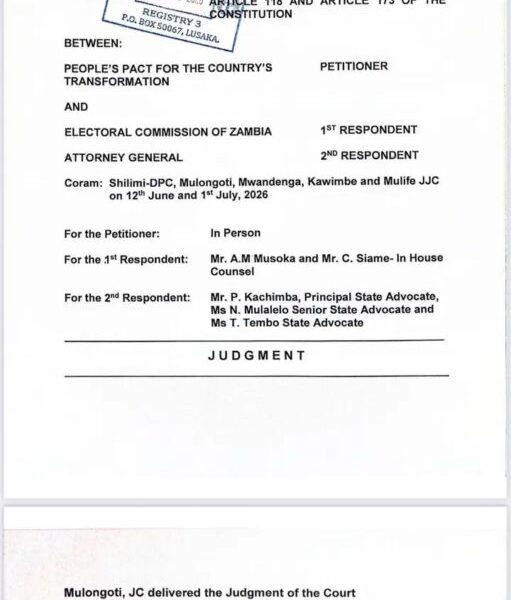
So, the matter goes to court.
And the petitioner basically says: “My Lord, ECZ has turned Article 100 into a group project where one person can quietly sabotage the whole assignment.”
But the Constitutional Court, in classic Mulongoti style constitutional common sense, leans back and says:
“Not so fast.”
Article 100, the Court says, is the Bible of qualifications. It tells you who may enter the presidential race.
But Article 52 is the gate procedure. It tells you how you show up, how you file your papers, and how the returning officer confirms you are not just a confident man with stationery.
ECZ, the Court says, is not inventing new qualifications. It is simply asking for proof that your party actually sent you, because in Zambian politics, enthusiasm alone is not sponsorship.
A man may declare himself candidate. His party may declare silence. And ECZ must not run on he said, she said, and he signed maybe.
WHAT THIS MEANS FOR THE ORDINARY CITIZEN IS SIMPLE?
You still have your democratic rights intact. Nobody has added new hurdles to who can be President. But when you enter the race, you must still respect the administrative road signs, even if they feel like they were written after a long committee meeting and one too many biscuits.
Moral of the story?
In democracy, ambition may be personal, but entry into the race is procedural. Or put simply, you can want State House all you like, but if your party’s two top signatures are not in agreement, even your presidency will remain pending approval like a delayed mobile money transaction.
Disclaimer:
My commentary on this decision is no more a legal critique than a campfire tale is a treatise on thermodynamics. It is, rather, a dramatized retelling, a lively reenactment if you will, of the judicial clash, unburdened by the solemn drudgery of analysis and delivered with the unapologetic zest of a storyteller who knows a good duel when he sees one.