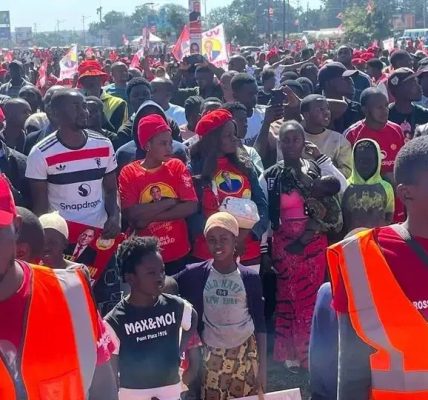
The historical challenges faced by the UPND in 2006, 2008, 2015, 2016 and 2021 during previous election campaigns are well documented. Having been involved in several Presidential campaigns in 1991, 2001 , 2006, 2015, 2016 elections, I am fully aware that UPND and other opposition parties faced severe democratic restrictions, with Police brutality and denial of police “permits” to hold rallies because of “security concerns” or “manpower shortages” and unequal airtime on the public broadcaster, ZNBC; denial to air majority of the television and radio adverts, as well as targeted blocks on aerial (planes and helicopters) transport by the Zambia Airforce. Incessant complaints to the Electoral Commission to rectify these anomalies fell on deaf ears. Appeals to the Police, Zambia Airforce, Electoral Commission were met with institutional inertia and indifference. Each one of them were impervious to our requests for intervention. These events are “never again” lessons. This intolerance must now be buried in the dustbin of history, it belongs to the graveyard of dead ideas.
As we go into our General Election in August of this year, let’s all remember that democracies need outlets for dissent, humour, satire and even frustration. The fragile beauty of a democracy is not found in the silence of consensus, but in the noise of disagreement. As we stand on the precipice of our General Election, the air is naturally thick with tension of competing visions and high stakes of power. In such moments, there is a dangerous temptation for those in power and authority, even those seeking it, to view dissent as a threat, satire as a subversion, and frustration as a sign of instability. However, as we prepare to cast our ballots, we must remember that a healthy democracy does not merely tolerate outlets of dissent, humour, satire, and frustration; it requires them to survive.
To understand why these outlets are essential, we must first recognise what a democracy is at its core. It is not just a series of administrative hurdles or a trip to a polling station. It is a living conversation. For that conversation to be honest, it cannot be edited by the thin-skinned or the self-important. When we suppress the right to be angry or the right to laugh at our leaders, we are not protecting the state; we are suffocating the very spirit that makes the state worth living in.
Dissent is the most fundamental of these outlets. In the heat of an election, political parties often demand total loyalty. They frame the world in binaries: you are either with us or against us. But the citizen’s duty is not to be a cheerleader; it is to be a critic. It is a safety valve that prevents social pressure from building into an explosion. When people feel they have no legitimate ways to say “no” or to protest a policy without being labeled an enemy of the state, they eventually find ways to make their voices heard, as Zambians did for instance in 1991 and 2021. By protecting dissent, we ensure that the political process remains a peaceful alternative to conflict.
Then there is a role of humour and satire. Satire is a unique and potent form of political participation. It takes the grandiosity of the powerful and shrinks it down to human size. In an election season, candidates often wrap themselves in a cloak of infallibility or divine purpose. Satire, whether it is a cartoon, a late night monologue, or a viral meme – pokes holes into that cloak. It reminds us that our leaders are just people, prone to the same follies and vanities as the rest of us.
Humour allows us to discuss the “undiscussable”. It breaks the ice on difficult topics and makes the bitter pill of political reality easier to swallow. More importantly, it creates a shared language among the citizenry. When we laugh together at a satirical take on a politician’s broken promise, we are reinforcing our shared reality. Satire is a mirror held up to power, and if the powerful don’t like what we see, the fault lies with the image, not the mirror. A government that fears a joke is a government that fears its own people.
We must also make space for frustration. Elections are inherently frustrating. They are messy, often disappointing, and frequently feel like a choice between the lesser of two evils. We should not expect citizens to be perpetually stoic or polite. When a voter expresses, for instance, anger at the cost of living, the quality of healthcare, or slow pace of change, that frustration is a data point. It is a demand for better. To dismiss this frustration as “incivility” or “negativity” is a tactic used to silence legitimate grievances. A democracy that demands “politeness” over “progress” is a democracy in decay.
As we go to the polls, we will see candidates who are sensitive to criticism. We will see supporters who want to shut down those who mock their “heroes.” We must resist this urge. The strength of our nation is measured by the breadth of the speech we allow. We must protect the right of the columnist to be scathing, the comedian to be irreverent, and the protestor to be loud.
These outlets serve the ultimate check and balance. While the courts and the legislature provide the formal structure of our democracy, dissent and satire provide its pulse. They keep the powerful humble and the public engaged. They ensure that even the person who loses the election feels they still have a voice in the room.
The role of the Police during an election is often the most difficult: they must be calm referees in a stadium where everyone is screaming. It is not the role of the police to decide who can or cannot hold a public rally. The role of the public broadcaster is not to be a “vuvuzela” of the government, but to serve as an impartial platform that provides equitable, balanced, and fact based information to all citizens, regardless of political affiliation, nor is it the role of ZNBC to decide which paid for television or radio programme can be aired and when. The role of the Zambia Airforce is not to decide who can fly by helicopter to a destination for a public political rally.
In the coming weeks, emotions will run high. Arguments will break out at our dinner tables and on social media. In those moments, let us remember that the ability to disagree, to mock, and to vent is what separates us from the darkness of authoritarianism. Our vote is our power, but our voice in all its messy, funny, and angry forms, is our freedom. Let us vote with our heads but let us keep our mouths open and our sense of humour intact. That is how we ensure that, no matter who wins the election, democracy itself remains undefeated.
Do you agree that child defilers should be castrated?
Total Votes: 756
Your email address will not be published.
23 Parirenyatwa Road
Rhodes Park
P.O. Box 32147
Lusaka, Zambia
Telephone or WhatsApp:
+26-097-7708285
+26-095-3424603
+26-096-5815078
Email:
diggers [at] diggers [dot] news
editor [at] diggers [dot] news