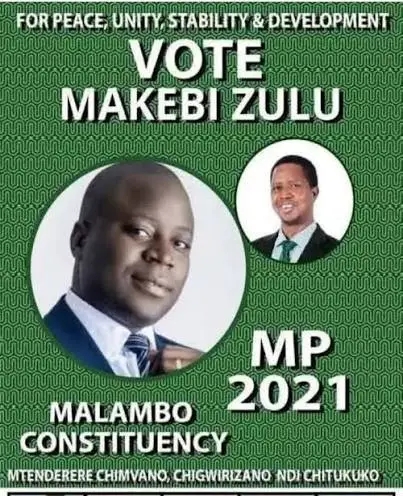

MAKEBI ZULU’S BIGGEST PROBLEM IS NOT UPND. IT IS MALAMBO.
By George Mtonga
As Zambia approaches another critical election cycle, political parties are once again presenting candidates as the solution to the country’s challenges. Speeches are being made. Alliances are being formed. Promises are being repeated.
But before voters become distracted by campaign slogans and political theatre, there is one fundamental question that should be asked of every aspiring national leader:
What happened when you were given the opportunity to lead before?
For Makebi Zulu, that question leads directly to Malambo Constituency.
In politics, there is no performance review more important than an election. There is no report card more powerful than the ballot box. There is no verdict more credible than the judgment of the people who have lived under your leadership.
And the people of Malambo have already rendered their verdict.
They rejected Makebi Zulu.
Not after hearing rumours.
Not after reading newspaper headlines.
Not after listening to political opponents.
They rejected him after experiencing his leadership firsthand.
They knew him as their Member of Parliament.
They knew him as a Provincial Minister.
They watched him operate from a position of power.
They observed his priorities.
They assessed his performance.
And when the opportunity came to renew his mandate, they removed him from office.
That reality should concern every Zambian now being asked to consider him as part of the Tonse Alliance leadership.
After all, if the people who knew him best decided he should no longer represent them, why should the rest of Zambia be convinced that he deserves promotion?
This is not a personal question.
It is a political one.
The office of Member of Parliament is the most direct test of leadership in our democracy. Unlike national politics, where candidates can rely on party structures, regional voting patterns, or broad campaign messages, a constituency election is deeply personal.
Voters know whether their roads improved.
They know whether their schools received attention.
They know whether their health facilities became better.
They know whether their representative was present when needed.
They know whether promises became reality.
And in Malambo, the voters made a decision.
They wanted change.
Supporters of Makebi Zulu will argue that many PF candidates lost in 2021.
That is true.
But strong leaders are often able to maintain support because they establish trust and credibility independent of party popularity.
The fact remains that Malambo was not willing to send Makebi Zulu back to Parliament.
That fact cannot be erased.
Nor can it be explained away by blaming UPND.
The people who removed Makebi Zulu were not UPND officials.
They were voters.
The same voters whose interests he was elected to serve.
What makes this issue even more significant is that Makebi Zulu has spent much of the post-2021 period positioning himself as a critic of government rather than explaining his own record in office.
He speaks frequently about constitutional matters.
He comments on legal disputes.
He participates in political debates.
But Zambians deserve answers about performance.
What exactly is the developmental legacy of Makebi Zulu in Malambo?
What major transformation occurred under his leadership?
What evidence exists that his constituency became a model of economic progress?
What achievements justify a promotion from rejected MP to national leader?
These are not unfair questions.
They are the same questions voters ask every leader.
In fact, they are the same questions Makebi Zulu asks of others.
Leadership is not about identifying the weaknesses of your opponents.
Leadership is about demonstrating your own success.
And that is where the challenge begins.
The Tonse Alliance appears determined to market itself as an alternative government. Yet many of its leading figures are individuals who already had an opportunity to govern Zambia between 2011 and 2021.
Zambians remember that period.
They remember the promises.
They remember the controversies.
They remember the economic difficulties.
They remember the debt accumulation.
They remember the governance concerns.
And they remember the election result.
When voters rejected PF in 2021, they were not simply changing a political party.
They were demanding a different direction.
Today, many of the same faces are asking for another opportunity.
That is their democratic right.
But voters also have the democratic right to ask what has changed.
In the case of Makebi Zulu, the answer remains unclear.
His strongest qualification appears to be his ability to defend political allies and articulate legal arguments.
But Zambia does not need a courtroom advocate.
Zambia needs leaders who can grow the economy, create jobs, improve public services, expand opportunities, and deliver measurable results.
Those are the standards by which national leaders should be judged.
Ultimately, the greatest obstacle facing Makebi Zulu is not UPND.
It is not the Electoral Commission.
It is not state institutions.
It is not political opponents.
His greatest obstacle is the political reality that the people of Malambo already evaluated his leadership and decided it was not good enough to continue.
That verdict remains part of his political record.
And until he can convincingly explain why the people he represented chose to remove him, Zambia has every reason to approach his national ambitions with caution.
Because before a leader asks an entire nation for trust, he must first explain why he lost the trust of those closest to him.
And that is a question Makebi Zulu still has not answered.