
Who Has Really Been Ruling Zambia Over the Last Five Years? The Missing Symbols of Power
Life is filled with symbols. These symbols whether literal or metaphorical help us understand deeper realities. Sometimes, no matter how factual an event or position may be, it feels incomplete without its accompanying symbols.
In marriage, intimacy consummates the union. A couple may have been together for 50 years, but without that physical consummation, many would argue the marriage was never fully realised. In employment, a salary is the key symbol. You may have an office and title, but without a paycheck from that organisation, your claim to employment remains questionable.
In religion, initiation or formal acceptance marks full belonging. In Christianity, it is confession, acceptance of Jesus Christ, and often baptism. In Islam, it involves the Shahada and adherence to the Five Pillars. In Hinduism, rituals like Upanayana or other samskaras serve similar roles. In the occult, specific rituals bind the practitioner. Without these symbols, full membership feels unfulfilled.
The same principle applies to the Presidency in Zambia. Certain symbols affirm and consummate the office. Without them, questions arise about whether the presidency has been fully exercised.
1. Instruments of Power
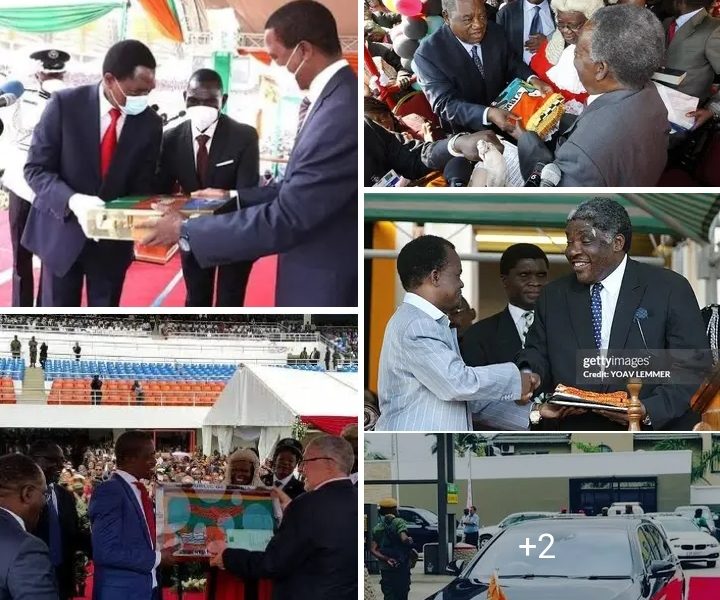
A president may win a legitimate election, but the physical handover of the Instruments of Power (the symbols of authority) formally transfers executive control. This ceremonial act is why outgoing presidents traditionally hand them over. In 2021, these instruments were handed to President Hakainde Hichilema. However, there was an additional person during the transition. Who truly received and has wielded them?
In 2014, when President Michael passed away, constitutionally it was Guy Scot who was to assume the role of acting President, however the instruments of power were in the Hands of ECL and ECL had to give them to Guy Scot in order for Guy Scot to fully function as acting President.
2. Residence at State House
A president traditionally resides at State House (or Nkwanzi House). Even before independence, colonial administrators and Zambia’s first Prime Minister, Kenneth Kaunda (prior to becoming President), operated from these buildings. The seat of power carries symbolic weight. A pastor’s words carry more authority from the pulpit than anywhere else; similarly, a president’s authority resonates most strongly from the official residence. That’s why another term for running for office is called “The Race to Plot 1”
In the last five years, who has primarily occupied State House? President Hichilema has used it for official functions but reportedly resides primarily at his private Community House in New Kasama. In life, nature abhors a vacuum, where has the symbolic heart of the presidency truly been?
3. The Title “Your Excellency” / “His Excellency”
Names and titles hold immense power. In the Bible, God asked Adam to name the animals, and Moses asked for the name of the One who sent him. A thing becomes what it is partly through the name it bears.
This may be the most significant symbol. President Hakainde Hichilema has publicly preferred to be addressed as “Mr. President” rather than “His Excellency the President.” While “Mr. President” is informal and democratic-sounding, “Your Excellency” / “His Excellency” remains the official and prestigious title for the Head of State. Zambia has many “Mr. Presidents,” but only one “Your Excellency.” Who has embodied this title over the last five years?
4. Salary
To claim genuine employment, one must typically receive compensation. President Hichilema, a successful businessman, has stated that he does not draw the presidential salary (reportedly around K53,000 monthly at one point, though figures vary). He has described himself as serving without pay, likening his role to a “missionary.” If the official salary has not been received by him, what does this mean symbolically for the presidency?
5. Eagle 1 The Presidential Mercedes-Benz
Some symbols seem minor but carry deep national meaning. The official presidential vehicle, famously known as Eagle 1, is traditionally a Mercedes-Benz. While a president can travel in any secure vehicle, the specific designation “Eagle 1” is reserved for the symbolic state car. Why has this particular Mercedes retained its unique status and recognition?
There are many more symbols of the Zambian presidency. While some may dismiss them as inconsequential, symbols and reality are intertwined. They consummate authority. Past presidents have missed individual symbols, sparking speculation (e.g., claims about Frederick Chiluba and military attire). Rarely, however, have so many core symbols appeared missing or redirected simultaneously.
So the deeper question remains: Who has truly been accorded these symbols over the last five years? Who has invisibly carried the title “Your Excellency,” occupied the symbolic presidential plot 1, received the emoluments, and moved with the full weight of Eagle 1?
Michael M. Mulusa
A Voice
Campaign message theliz NO!!! Opposition is really looking for relevance…..just tell us what Mundubile and Makebi accomplished in government and what they will do differently if ever in power again and how they will raise money for what ever they claim
Irrelevant issues.Ours is to focus on the economy. Those lamentations are for people who are bored and have got nothing to offer