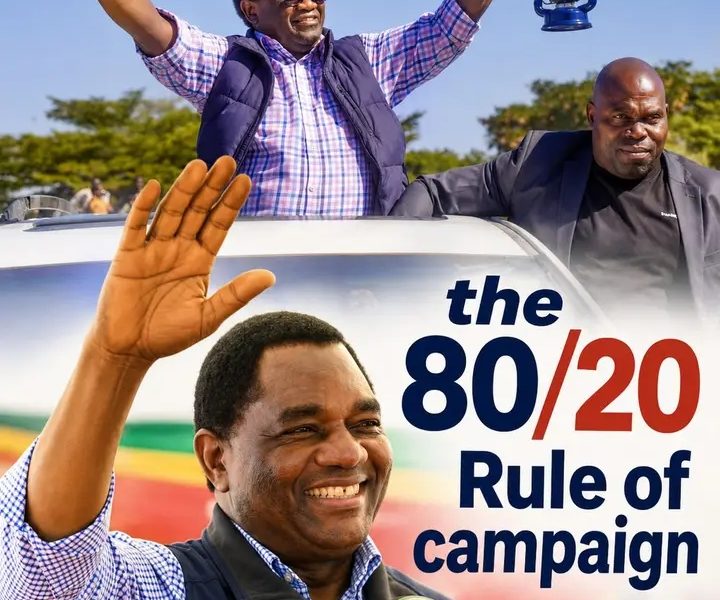

THE 80/20 RULE: WHY THE SMARTEST CAMPAIGNS DON’T CHASE EVERY VOTE, THEY CHASE THE RIGHT ONES
Every election season, campaign teams make the same costly mistake. They try to be everywhere, speak to everyone, and fight every battle. They spread themselves so thin that by election day, they have touched a million people lightly and moved almost none of them deeply.
There is a smarter way. It is called the 80/20 rule, and it could be the single most underused weapon in Zambian politics today.
WHAT IS THE 80/20 RULE ANYWAY
The principle is simple. Roughly 80 percent of your results will come from just 20 percent of your effort. An Italian economist named Vilfredo Pareto noticed this pattern over a century ago when he observed that 20 percent of the pea pods in his garden produced 80 percent of the peas. Since then, the same pattern has shown up everywhere, from business to farming to war strategy.
In a campaign, it means this. Not all wards matter equally. Not all voters are equally persuadable. Not all messages carry equal weight. Not all volunteers deliver equal results. The candidate who identifies that vital 20 percent and pours resources into it will outperform the candidate who spreads butter thinly across the whole loaf.
FINDING YOUR 20 PERCENT OF WARDS
Every constituency has a handful of wards that decide the outcome. Some wards are locked in already, whichever way they lean. Others are truly contested and will swing the result. A campaign with limited fuel, limited manpower, and limited time cannot afford to treat a stronghold the same way it treats a battleground.
Smart campaigns map their constituency like a general maps a battlefield. Where are the swing wards. Where did the last election get decided by a handful of votes. Where does the opposition have weak structures that can be broken. That is where the door to door teams go. That is where the rallies get concentrated. That is where the resources land, not scattered evenly across every corner of the map.
FINDING YOUR 20 PERCENT OF VOTERS
Inside every ward there are also three kinds of voters. Those who will vote for you no matter what. Those who will never vote for you no matter what. And those in the middle who are genuinely undecided or only loosely attached to a party.
Chasing the first group wastes time they are already yours. Chasing the second group wastes time they were never going to be yours. The real prize is that middle group, often much smaller than people assume, and it is exactly there that a well targeted message, a personal visit, or a piece of real development delivered on time can flip an election.
FINDING YOUR 20 PERCENT OF MESSAGES
A campaign that tries to talk about everything, ends up remembered for nothing. Voters are bombarded daily with noise from every direction. They will only retain a handful of ideas about any candidate.
This is why disciplined campaigns pick their two or three strongest messages and hammer them relentlessly, rather than releasing a new theme every week. If the story is economic stabilisation, debt relief, and free education, then every speech, every poster, and every post should circle back to those pillars. Repetition is not boring, repetition is how a message survives in a voter’s memory until election day.
FINDING YOUR 20 PERCENT OF PEOPLE
Not every volunteer, agent, or campaign structure member contributes equally. Every campaign has a small core who show up early, mobilise their neighbours, and carry the message with genuine conviction. Identifying and empowering these people, rather than spreading trust evenly across a large but uneven team, multiplies output.
Give your best mobilisers the resources, the recognition, and the responsibility they have earned. A campaign of one hundred lukewarm volunteers will always lose to a campaign of twenty fiercely loyal ones.
WHY THIS MATTERS MORE THAN EVER IN THIS CAMPAIGN
With the general election now fast approaching, time, money, and energy are the three things no campaign has enough of. The candidates who win will not necessarily be those who worked the hardest. They will be those who worked the smartest, who understood that focus beats scatter every single time.
The opposition will keep shouting in every direction, hoping something sticks. The disciplined campaign does not need to shout everywhere. It needs to shout in the right twenty percent, loud enough, and consistently enough, to move the eighty percent that decides who governs Zambia next.
That is not a shortcut. That is strategy.
________
Zambian Angle