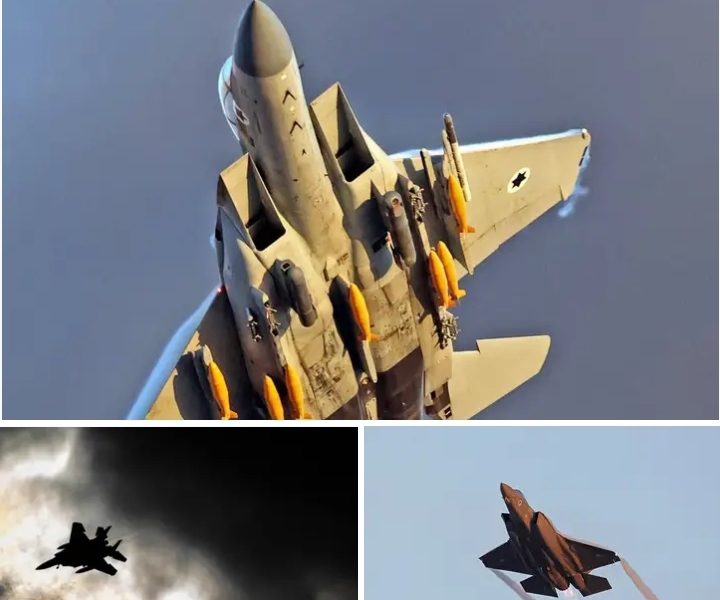
Trump’s F-35 gamble: Why the White House wants to arm Turkey despite fierce opposition from Congress and Israel

Trump’s F-35 gamble: Why the White House wants to arm Turkey despite fierce opposition from Congress and Israel
A dramatic new fault line has emerged in American foreign policy after President Donald Trump signaled his willingness to restore Turkey’s access to the world’s most advanced stealth fighter – the F-35 – despite fierce opposition from bipartisan lawmakers, national security experts and one of Washington’s closest allies in the Middle East, Israel.
The proposal has ignited a political firestorm in Washington, where members of Congress argue that allowing Turkey back into the F-35 programme would violate existing US law, reward a NATO ally that continues to possess Russia’s controversial S-400 missile defence system, and potentially weaken America’s strategic military advantage in one of the world’s most volatile regions.
The controversy follows President Trump’s recent remarks that he would “probably do something” that would make Turkish President Recep Tayyip Erdoğan “very happy,” fueling widespread speculation that the White House is considering lifting barriers preventing Ankara from rejoining the F-35 programme.
Why would Trump take such a politically risky step?
Behind the controversy lies a complex web of geopolitical calculations.
Keeping Turkey firmly inside NATO
Although relations between Washington and Ankara have deteriorated over the past decade, Turkey remains one of NATO’s most strategically valuable members.
Situated between Europe, the Middle East, the Black Sea and the Caucasus, Turkey controls access to the Black Sea through the Bosporus and Dardanelles straits, hosts critical NATO military installations and plays a pivotal role in regional security.
The Trump administration appears to believe that rebuilding defence ties with Ankara could strengthen NATO unity at a time when Russia continues to challenge Western security and instability across the Middle East remains high.
Pulling Turkey away from Russia
Washington’s biggest concern has long been Turkey’s acquisition of Russia’s S-400 missile defence system in 2019.
That purchase triggered sanctions under the Countering America’s Adversaries Through Sanctions Act (CAATSA) and led directly to Turkey’s expulsion from the F-35 programme.
However, administration officials believe there may still be an opportunity to persuade Ankara to ultimately abandon or transfer the Russian system in exchange for renewed military cooperation with the United States.
Countering China’s growing influence
Turkey has increasingly diversified its defence partnerships beyond the West.
Should Washington permanently shut the door on Ankara, analysts warn that Turkey could deepen military cooperation with Russia or China while accelerating its indigenous fighter programme.
From the White House perspective, restoring strategic trust could prevent Turkey from drifting further away from the Western alliance.
Trump’s personal diplomacy with Erdoğan
President Trump has long maintained that personal relationships between leaders can unlock diplomatic breakthroughs where traditional diplomacy struggles.
Observers believe his relatively cordial relationship with President Erdoğan has encouraged the administration to explore a reset in bilateral relations despite significant political resistance in Washington.
Why Congress is pushing back
Congressional opposition is unusually bipartisan.
Lawmakers argue that federal law is explicit: Turkey cannot receive F-35 aircraft while it retains the Russian S-400 missile defence system.
The legal restrictions arise not only from CAATSA sanctions but also from provisions contained in the Fiscal Year 2020 National Defense Authorization Act, which prohibit the transfer of F-35s unless Turkey no longer possesses the S-400 system and provides assurances against acquiring similar systems in the future.
A bipartisan coalition of lawmakers is already preparing legislative measures to block any attempt by the administration to bypass those restrictions.
Israel’s growing unease
Perhaps nowhere is the proposal generating greater concern than in Jerusalem.
For decades, Israel has enjoyed a Qualitative Military Edge, QME, – a longstanding US policy ensuring that Israel maintains superior military capabilities over potential regional adversaries.
Israeli officials fear that supplying fifth-generation stealth fighters to Turkey could significantly alter the regional balance of power, particularly as relations between Ankara and Jerusalem have sharply deteriorated over the Gaza conflict and broader Middle East tensions.
Israeli officials also worry that advanced F-35 technologies, some incorporating Israeli-developed systems and components, could eventually become vulnerable if operated alongside Russian military equipment.
A decision with global consequences
Beyond Israel and Turkey, the outcome could reshape security dynamics across the Eastern Mediterranean.
Greece and Cyprus have also expressed serious reservations, arguing that equipping Turkey with the F-35 would embolden Ankara’s increasingly assertive regional posture.
If President Trump ultimately succeeds in restoring Turkey’s access to the aircraft, it would mark one of the most consequential reversals in US defence policy since Turkey was expelled from the programme in 2019.
If Congress blocks the move, it would reinforce lawmakers’ determination to preserve statutory restrictions on countries that acquire advanced Russian military systems.
Either way, the battle over the F-35 has evolved into far more than a dispute over fighter jets. It has become a test of American law, NATO unity, Middle East security and the delicate balance between presidential diplomacy and congressional authority.
As Washington weighs strategic necessity against legal obligation, the world is watching closely. Whatever decision emerges is likely to reverberate across NATO, the Middle East and the global defence landscape for years to come.