
STEPHENSON BARRACKS
The name before Arakan Barracks
During the Federation period, what we now know as Arakan Barracks was called Stephenson Barracks.
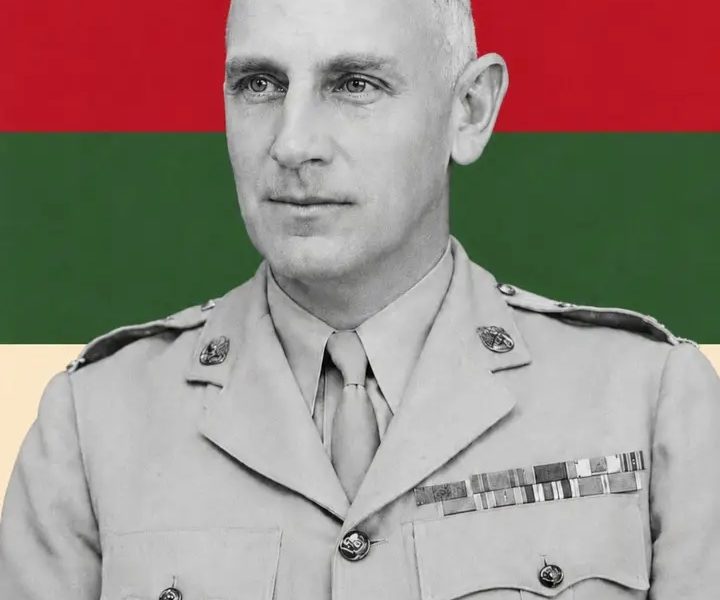
That name belonged to Colonel Arthur Stephenson, CMG, CBE, DSO, MC. He is described by Brelsford as one of the out-of-the-ordinary characters of Northern Rhodesia.
Stephenson first came to Africa to serve in the Boer War. He later moved to Northern Rhodesia in 1904 and joined the British South Africa Company, where he served in several capacities, including as Postmaster at Kalomo when Kalomo was the capital.
When the First World War broke out, he returned home and was commissioned in the King’s Own Light Infantry. During the war, he held various command roles and received significant decorations.
After the war, Stephenson returned to Northern Rhodesia. From 1919 to 1925, he served as Commandant of the Northern Rhodesia Rifles, a white volunteer force associated with the colony’s early defence structures.
In 1925, he moved from military command into police command and became Commandant of the Northern Rhodesia Police, serving at the rank of Lieutenant-Colonel until 1930.
From 1925 to 1930, he was also a nominated member of the Legislative Council. After retiring from the police in 1930, he took up a post in the copper mines, organising recruitment and labour. During this period, he was also elected to the Legislative Council, a rare occurrence because it was unusual for one person to have served as both a nominated and elected member.
In 1939, at the age of 58, he was appointed Commander of the British Empire. That same year, he became Sub-Area Commander for the Northern Rhodesia Area.
He finally left the Army in 1942 and later became Manager of the Chamber of Mines in Kitwe until 1945, when he went to Southern Rhodesia as Northern Rhodesia Labour Officer.
He died in 1950, after a lifetime of civil, military, police and labour service connected to Northern Rhodesia.
In May 1958, the Federal authorities named several military installations after men they regarded as important soldiers in Central African military history. The Lusaka military area was named Stephenson Barracks after Lieutenant-Colonel A. Stephenson. In the same naming pattern, Zomba Cantonment in Nyasaland became Cobbe Barracks, while parts of the Southern Rhodesian military establishment carried names such as Llewellin and Methuen.
Arthur Stephenson was therefore not a passing name in the Northern Rhodesian military story.
He had served in the Boer War, fought in the First World War, commanded the Northern Rhodesia Rifles, led the Northern Rhodesia Police, served in the Legislative Council, and returned to military responsibility during the Second World War. His decorations included the DSO and MC, and he also carried the honours CMG and CBE.
But Stephenson’s story was not only about command.
He also appears in regimental memory as one of the men who helped shape the material heritage of the regiment.
In 1928, while serving as Commandant of the Northern Rhodesia Regiment, Lieutenant-Colonel Stephenson started the tradition of collecting relics, trophies and firearms for the Officers’ Mess. Before the 1939–45 war, the Officers’ Mess already had an extremely good collection of firearms. Stephenson contacted interested District Commissioners and obtained a remarkable number of muskets and rifles from Boma stores, confiscated or surrendered arms, and deceased estates where there were no claimants.
The collection included both military and sporting weapons. Among them were examples such as the Brown Bess, associated with famous British regiments such as the 42nd Highlanders and the Black Watch.
Other items included various machine guns and a 1-Pounder Hotchkiss gun from Fort Jameson. This gun was believed to have been removed from the German gunboat Hermann von Wissmann after she surrendered to the gunboat Gwendolen on Lake Nyasa in 1914
Some of these relics and trophies are still part of regimental memory today, with more found at the 2 Zambia Regiment (2nd Infantry Battalion) Officers’ Mess and at Arakan Barracks in general.
Stephenson also suggested that elephant tusks be placed in the Officers’ Mess after seeing a similar display at the Officers’ Mess in Zomba. The tusks were provided by the Controller of Stores and Transport from government-owned ivory, initially as a permanent loan to the regiment.
Today, there are actually two pairs of tusks in the 2nd Infantry Battalion Officers’ Mess. One set is in the lounge and another in the dining room.
That detail is important because it shows that Stephenson was not only part of the command structure. He was also part of the making of military memory. He helped collect, preserve and display the objects through which soldiers remembered campaigns, battles, service, authority and regimental identity.
Of course, that memory system reflected its time. The trophies, relics and named spaces belonged to a colonial military world. They showed what the institution chose to preserve and how it chose to tell its story. In that world, the names of officers were often placed in front, while African soldiers, askari, porters and local communities often remained behind the curtain of history.
That is why the later renaming of Stephenson Barracks is so important.
When Stephenson Barracks became Arakan Barracks in 1964, just before Independence was announced, the memory shifted. The name no longer pointed mainly to one colonial officer. It pointed instead to a campaign theatre in which African soldiers from this region served, fought, endured and distinguished themselves during the Second World War.
That change was more than a change of signboard.
It was a change of memory and a more inclusive one too.
It is important for us to understand the naming system Zambia inherited. Names like Stephenson help us see how colonial military memory worked: who was honoured, whose objects were preserved, whose service was displayed, and whose names were left waiting to be recovered.
In the end, barrack names are not just labels.
They are history.
They are memory markers and lessons.
They tell us whose service was honoured, whose story was preserved, and whose name a nation chose to carry forward.
📸 Restored from an archival Northern Rhodesia Legislative Council photograph, 1940. Original source mark: rhodesia.me.uk.