
Global Witness Report Raises Serious Questions About Timing, Credibility and Political Intent
By Margaret Mwanza
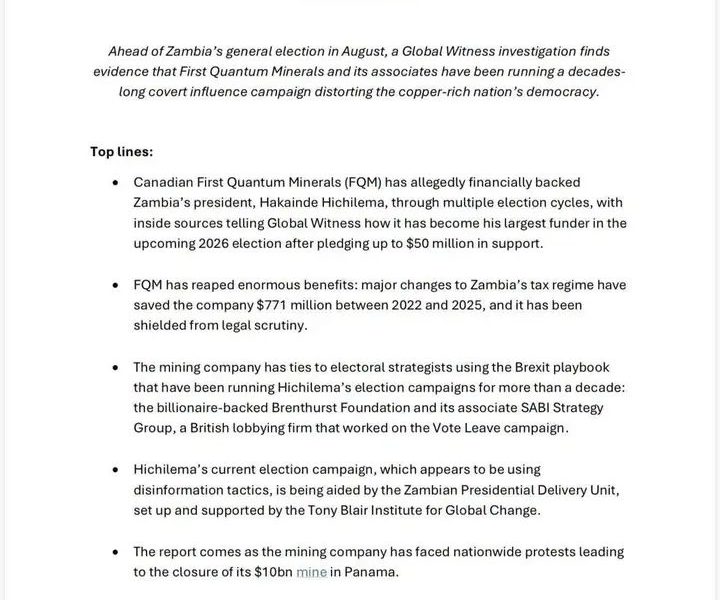
Recent reporting by the Zambia Daily Mail on 17 July 2026 indicates that London-based non-governmental organisation Global Witness is preparing to release a report containing allegations relating to the UPND government and Zambia’s mining sector ahead of the country’s general election.
While the report itself has not yet been publicly released, the issues raised by the Daily Mail’s coverage invite important questions about timing, methodology and the potential implications of publishing such allegations at a critical moment in Zambia’s democratic process..
The reported timing of the forthcoming report cannot be ignored. If Global Witness genuinely believed there were concerns surrounding campaign financing, political sponsorship or governance, why were these matters not brought forward in 2021 when they allegedly occurred, or at any stage during the four years that followed?
Presenting such allegations earlier would have provided sufficient time for independent investigations, legal processes and public scrutiny to take place. Instead, the report is expected to be released at the precise moment when public opinion is most susceptible to influence and when those who may be the subject of its allegations have the least opportunity to properly respond.
Such timing inevitably creates the perception that the report is intended to generate maximum political impact rather than facilitate a fair search for the truth. Ironically, an organisation that claims to protect democratic integrity risks being viewed as interfering in the democratic process of a sovereign nation by attempting to influence voters at the very point they are preparing to exercise their constitutional right.
Equally important is the question of evidence. According to the Zambia Daily Mail, the forthcoming report indicates that Global Witness cannot disclose the identities of its sources. While protecting confidential sources is an accepted journalistic principle, anonymity should never become a substitute for verifiable evidence.
The more serious the allegation, the greater the obligation to demonstrate that every claim has been independently corroborated and subjected to rigorous scrutiny. According to the newspaper’s account, many of the allegations rely on information provided by anonymous former employees, former civil servants and former business associates.
Every reasonable observer is entitled to ask what processes were followed to verify these claims, what efforts were made to test the credibility of these sources, and whether adequate consideration was given to any personal, political or commercial interests that may have influenced their testimony.
Dangerously, even more revealing is the Daily Mail’s report that the Global Witness document itself does not allege that any Zambian domestic or electoral laws were broken. That reported admission significantly changes the nature of the allegations. If there is no suggestion that any Zambian law has been violated, then the obvious question becomes what specific wrongdoing is actually being presented to the Zambian people?
Democratic societies cannot allow suspicion to replace evidence or allegations to replace proven facts. Public confidence in institutions is strengthened when accusations are supported by clear and verifiable proof, not by implication or inference.
It is also very clear that the forthcoming report also appears to present an incomplete picture of Zambia’s mining sector. While it reportedly critiques reforms to the mineral royalty regime as favouring mining companies, it reportedly makes no meaningful reference to the Local Content Regulations contained in Statutory Instrument No. 68 of 2025, which came into effect on 1 January 2026.
These regulations represent one of the most significant reforms aimed at increasing Zambian participation in the mining industry by requiring mining companies to progressively reserve procurement opportunities for Zambian-owned businesses, beginning at 20 percent and rising to 40 percent over five years, while also providing a 15 percent bid preference for local suppliers.
Whether one agrees with every aspect of government policy or not, any balanced assessment of Zambia’s mining reforms should acknowledge both the incentives provided to investors and the measures introduced to empower local businesses. Omitting such a significant policy development inevitably creates the impression of selective reporting rather than comprehensive analysis.
Perhaps the greatest danger of a report built around allegations that have yet to be tested is not what it says, but how it will inevitably be used. The moment such a document enters the public domain, it becomes a ready-made political weapon for opposition propagandists and partisan activists who have spent years attempting to portray Zambia’s mining sector and the UPND government in the worst possible light.
Figures such as Emmanuel Mwamba are almost certain to seize upon its contents, presenting allegations as settled facts in an effort to reinforce their long-held political narratives and influence public opinion ahead of the election. It is clear the timing of this publication at the peak of the election campaign is intended to disrupt, allowing no time for debate or interrogations of the allegations. This level of irresponsibility is an assault on Zambia’ democratic process.
That is why organisations releasing reports with such profound political and economic implications carry a duty that extends far beyond publication. They must ensure that every allegation is supported by compelling evidence and capable of withstanding the highest level of independent scrutiny, particularly when the report is released at the height of an election campaign.
Democracy depends upon citizens making informed decisions based on verified facts rather than carefully timed allegations. International organisations undoubtedly have an important role in exposing corruption and promoting transparency wherever credible evidence exists. However, that responsibility also demands impartiality, consistency and the highest standards of professional integrity.
Scheduling the release of politically sensitive allegations just weeks before a national election, while reportedly acknowledging that no domestic electoral or criminal laws are alleged to have been breached, inevitably invites scrutiny of both the report’s methodology and its broader intentions.
Reports of this nature should enlighten public debate, not become instruments that risk influencing electoral outcomes through untested claims.
Zambia is an independent and sovereign republic with functioning institutions, competent investigative agencies and courts capable of examining credible allegations wherever evidence exists.
It is ultimately the Zambian people, and not foreign organisations, who will determine the future leadership of this country through the ballot box. While Global Witness may believe it is advancing the cause of transparency, transparency cannot be measured by the volume of allegations or the headlines they generate. It must be measured by the strength of the evidence, the fairness of the process and the consistency with which those standards are applied.Reports released on the eve of a national election carry enormous political consequences and, for that reason alone, must meet the highest threshold of credibility and impartiality.
Zambia’s democracy belongs to its citizens, not to external advocacy groups, foreign interests or international campaigns seeking to shape the national conversation at the most politically sensitive moment. The Zambian people deserve facts that can withstand scrutiny, not allegations that cannot be fully tested before ballots are cast. In the end, it is the sovereign will of the Zambian electorate, expressed freely through the ballot box, that must prevail over speculation, innuendo and externally driven political narratives.
Serious allegations require serious evidence. Anything less risks undermining not only the credibility of those making the accusations, but also the democratic principles they claim to uphold.