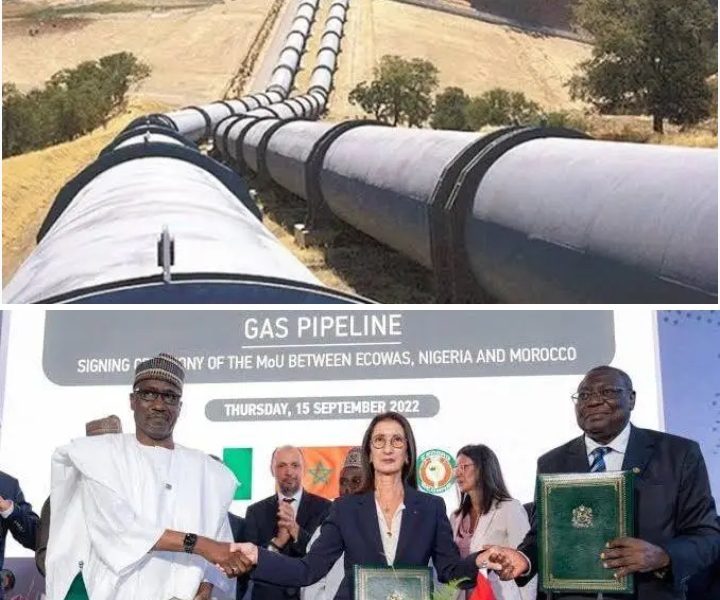

ECOWAS Approves $25 Billion Nigeria–Morocco Atlantic Gas Pipeline Project
On July 19, 2026, West African leaders meeting at the ECOWAS Heads of State Summit in Freetown, Sierra Leone, officially signed the Intergovernmental Agreement (IGA) authorizing the construction of the $25 billion.
Nigeria–Morocco Atlantic Gas Pipeline (AAGP), marking a major milestone for one of Africa’s most ambitious energy infrastructure projects.
The hybrid onshore-offshore pipeline will extend between 6,000 and 6,900 kilometres along Africa’s Atlantic coastline. Once completed, it is expected to transport 30 billion cubic metres (bcm) of natural gas annually from Nigeria. Of that volume, 15 bcm per year will be supplied to Morocco and European markets through a connection to the existing Maghreb-Europe Gas Pipeline, which links Morocco to Spain.
Construction is expected to commence in 2028, with the first gas deliveries projected for 2031.
A Transformational Regional Project
The pipeline will traverse 13 African countries along the Atlantic coast: Benin, Togo, Ghana, Côte d’Ivoire, Liberia, Sierra Leone, Guinea, Guinea-Bissau, The Gambia, Senegal, Mauritania, Morocco, and Nigeria.
It will also include planned interconnections to provide natural gas access to several landlocked Sahel countries.
Developed jointly by Nigeria’s NNPC Ltd. and Morocco’s National Office of Hydrocarbons and Mines (ONHYM), the project is expected to:
Strengthen energy security by expanding electricity generation and reducing energy costs across West Africa.
Accelerate industrialization by supporting manufacturing, mining, and related infrastructure development.
Deepen regional economic integration by creating a strategic energy corridor linking West Africa, North Africa, and Europe.
Next Steps:
With both the feasibility study and Front-End Engineering Design (FEED) successfully completed, the project now enters its implementation phase.
The next milestones include the signing of a bilateral agreement between Morocco and Mauritania in the presence of Nigeria’s President, the establishment of a dedicated project company in Casablanca and a Pipeline Higher Authority in Abuja, as well as the mobilization of investors ahead of the Final Investment Decision (FID).
If delivered on schedule, the Nigeria–Morocco Atlantic Gas Pipeline will become one of the world’s longest offshore gas pipelines and a landmark project capable of reshaping Africa’s energy landscape while strengthening economic ties between Africa and Europe.