
The Assassin Who Sparked World War I: Gavrilo Princip and the Event That Changed History
HISTORICAL FEATURE
Gavrilo Princip, the young Bosnian Serb nationalist whose assassination of Archduke Franz Ferdinand is widely regarded as the spark that ignited World War I, remains one of the most consequential figures in modern history.
Princip, a student of Serbian ethnicity, was reportedly rejected from military service because of his small stature. Determined to prove himself, he joined a nationalist movement seeking to end Austro-Hungarian rule in Bosnia.
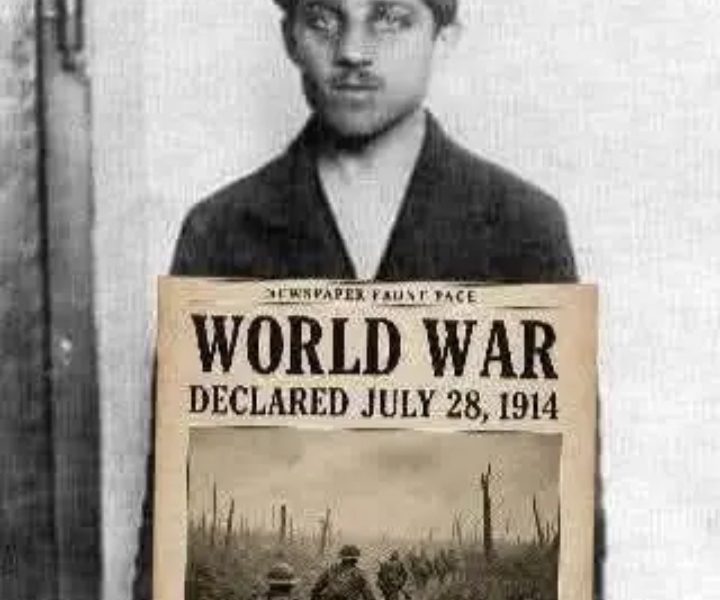
On June 28, 1914 not July 28 Princip shot and killed Archduke Franz Ferdinand, heir to the Austro-Hungarian throne, and his wife, Sophie, during their visit to Sarajevo, Bosnia. The assassination triggered a diplomatic crisis that rapidly escalated into a global conflict.
Austria-Hungary blamed Serbia for the attack and declared war on the country on July 28, 1914. A complex network of military alliances soon drew Europe’s major powers into the conflict:
Austria-Hungary declared war on Serbia.
Russia mobilized in support of Serbia.
Germany declared war on Russia and then France.
Germany invaded Belgium as part of its offensive against France.
Britain declared war on Germany after Belgium’s neutrality was violated.
The Ottoman Empire later entered the war on the side of the Central Powers, while Italy, Romania, Greece, Portugal, and eventually the United States joined the Allies at different stages of the conflict.
What began as the assassination of a single royal figure quickly evolved into the First World War, which lasted from 1914 to 1918 and fundamentally reshaped global politics.
Modern historical estimates indicate that around 15–20 million people were killed, including both military personnel and civilians, while more than 20 million others were wounded. Millions more were displaced, and the war contributed to the collapse of the Austro-Hungarian, Ottoman, German, and Russian empires.
Although Princip did not personally cause all of these events, historians generally agree that his assassination of Franz Ferdinand served as the immediate catalyst for a conflict that had been made increasingly likely by great-power rivalries, militarization, imperial competition, and rigid alliance systems.
Because of the immense human cost of the war, Gavrilo Princip is remembered as one of history’s most controversial figures. To some, he was a nationalist fighting foreign rule; to others, he was the assassin whose actions helped trigger one of the deadliest conflicts humanity had ever witnessed.