
Miracles, Mega Rallies, and the Arithmetic of Change
_A Reply to Wynter Kabimba_
By Professor Namukolo Miyanda, Pan-Africanist and Governance Expert
21st July, 2026
It will be a miracle for NRPUP to win, says Economic Front leader Wynter Kabimba. His reason: Brian Mundubile is not a “household name.”
If politics were a branding contest for soap or soda, Mr. Kabimba would have a point. But Zambians are not going to vote for household brands, otherwise “Mojo drink” or “charcoal” would claim victory, collectively or singularly. Elections are not won on the supermarket shelf. They are won in compounds, villages, and markets where lived experience beats advertising.
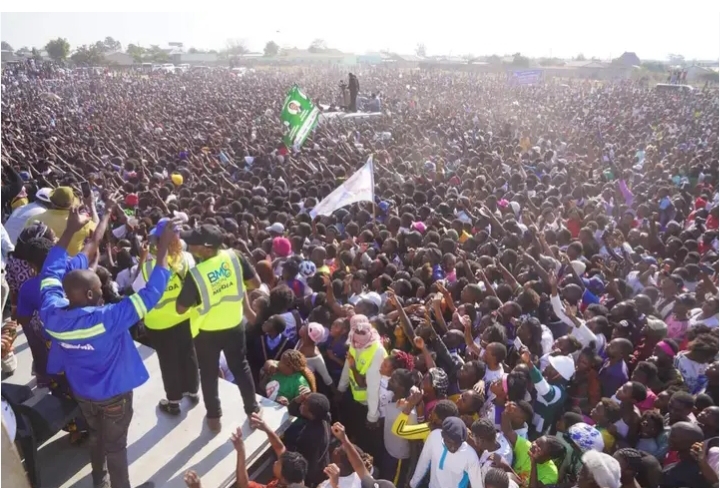
Zambia has already witnessed the first miracle Mr. Kabimba did not anticipate. That was the day the NRPUP was born and designated as a reliable special purpose vehicle for use during the 13th August, 2026 general elections. The second miracle was when the two political leaders, Brian Mundubile and Makebi Zulu united and resolved to work together ahead of the 13th August, 2026 general elections. The third miracle followed when the Electoral Commission of Zambia duly certified and accepted the nominations of Brian Mundubile and Makebi Zulu. We are sure even Mr. Kabimba regarded it as a miracle, though he is yet to tell us at what reading he would place it. For many Zambians, they put it at the third reading of a national shift. The fourth miracle is the ongoing resilience and unstoppable turnout of the people of Zambia to all ralles and roadshows organized by NRPUP across the country. The fourth miracle will be delivered by the Zambian people and Mr. Kabimba will witness it because change is unavoidable and the people are resolved to vote for that change. That change is to overwhelmingly turnout to vote on 13th August and usher in the NRPUP under the leadership of Brian Mundubile.
To dismiss a candidate because he is not a “household name” is to misread history and arithmetic. Household names are made, not inherited. They are made by necessity, by suffering, and by the failure of incumbents to keep their word. The analysis by Mr. Kabimba is misplaced and inept, especially considering the economic hardship Zambians are enduring today. Five years is long enough to measure a government.
Chinua Achebe, in _Things Fall Apart_, gives us Okonkwo’s uncle Uchendu. When Okonkwo sits bitter in exile, blaming others for his misfortune, Uchendu rebukes him. Bitterness is not a strategy. It blinds a man to the new season. Achebe warns us of the man in the village whose bitterness becomes his only argument. When political analysis is reduced to envy of another man’s crowd, it ceases to be analysis. It becomes a personal quarrel with reality.
Asked about Mundubile’s chances given the NRPUP’s mega rallies, Mr. Kabimba argued that Mundubile is “just very excited to find himself there,” that he has done nothing to prove he can do better for Zambia, and that Makebi Zulu “has no influence to give directions to the Easterners like RB.” He adds that Makebi Zulu lost an election as provincial minister and therefore cannot win a general election.
The argument lacks objectivity. African political history is littered with leaders who lost presidential elections or parliamentary seats before winning the presidency. In Botswana, Mokgweetsi Masisi lost a primary in 2004 before rising to the presidency in 2018. In Senegal, Abdoulaye Wade lost multiple legislative elections as an opposition candidate in the 1970s and later lost 4 presidential elections before being elected as president in 2000. In Ghana, John Agyekum Kufuor lost his first presidential bid in 1996 before winning in 2000. In Sierra Leone, Julius Maada Bio was defeated in 2012 before securing the presidency in 2018. In Zambia itself, Hakainde Hichilema lost 5 presidential elections before his 2021 victory. Defeat is not a disqualification. It is often a rehearsal.
To reduce Makebi Zulu’s influence to one past election is to ignore the chemistry of tickets, alliances, and national mood. Voters in 2026 are not hiring a provincial minister. They are hiring a government. And the issue they are weighing is not who lost what in 2021. It is who can change what is broken in 2026.
It is not surprising that Mr. Kabimba is pursuing this narrative. Of late, his public commentary has aligned sympathetically with the UPND and its leadership. That is his right. But sympathy is not evidence, and alignment is not analysis. The statements and comparisons Mr. Kabimba advances are no longer the issues Zambians are considering when they go to vote on 13th August, 2026.
The people are being guided by a single, overriding need: to change the political party in office and usher in an alternative. At this hour, the only available national alternative with structures, candidates, and momentum is the NRPUP. That is the realism Mr. Kabimba’s pocket calculator cannot compute.
Therefore, the Economic Front should concentrate on painting their own drawing board with the words “we admit, we are failures” and hoping to restrategize for the 2031 general elections, since this year’s election is a lost chance. It is understood that the Economic Front has been a perpetual underdog since its establishment, without a single parliamentary seat to its name. That record is not an insult. It is a fact that should invite introspection.
Sometimes, silence is the more strategic intervention. As Mark Twain famously put it: _“It is better to keep your mouth closed and let people think you are a fool than to open it and remove all doubt.”_ When one’s assessment of reality is detached from the hardship in the compounds, markets and bus stations, speech does not clarify. It confirms.
Serious politics runs on realism. Pretend politics runs on nostalgia for names. Psychologists say nostalgia can boost mood and give meaning. But in politics, relying on nostalgia can mean ignoring present problems. Achebe’s _”A Man of the People”_ warns about voters stuck in nostalgia who keep re-electing the same failed leaders. On 13th August 2026, Zambians will not be voting on who is a household name. They will be voting on who can turn the house around.